


An unattended death can affect parts of a home that show no visible damage. After authorities remove the deceased, biological fluids and decomposition odor may remain beneath flooring, inside furniture, or within other absorbent materials.
Understanding what happens after an unattended death helps you protect yourself and determine what the property needs next. Bio Recovery’s unattended death cleaning services assess the full affected area, remove contamination, treat salvageable materials, and prepare the space for repair or safe use.
What Happens After an Unattended Death Is Discovered?
Call 911, leave the immediate area, and do not touch the person or nearby objects. Emergency personnel must confirm the death before anyone changes the condition of the scene.
Follow these steps until help arrives:
- Leave the room or immediate area.
- Call 911 and follow the dispatcher’s instructions.
- Keep other people and pets away.
- Do not move the person or nearby belongings.
- Do not open windows, operate fans, or attempt to clean.
- Wait for authorities to release the property before arranging remediation.
These actions protect you and preserve conditions that may matter during the investigation. The same precautions apply whenever you need to determine what to do after finding a dead body, regardless of whether you know how or when the person died.
Who Conducts the Unattended Death Investigation?
Law enforcement usually secures and documents the scene. A medical examiner or coroner investigates the cause and manner of death according to state and local procedures.
The investigation may document the person’s position, surrounding conditions, available medical information, and statements from people connected to the deceased. The National Institute of Standards and Technology explains that a medicolegal death scene investigation helps authorities collect evidence and contextual information related to the death.
A longer investigation does not automatically mean that authorities suspect a crime. An unexpected or unexplained death may require additional review before the property can be released.
What Happens After Authorities Release the Home?
Once authorities release the scene, the owner or authorized representative can arrange property remediation. Body removal does not include cleaning biological material or repairing affected parts of the home.
Different professionals handle separate parts of the response. The division of responsibility covered in who cleans up after a death explains why law enforcement, medical examiners, funeral professionals, and cleanup technicians do not perform the same work.
The person authorizing remediation may be a homeowner, estate representative, landlord, or property manager. Bio Recovery confirms the release before assessing the property or changing its condition.
How Is a Home Assessed After an Unattended Death?
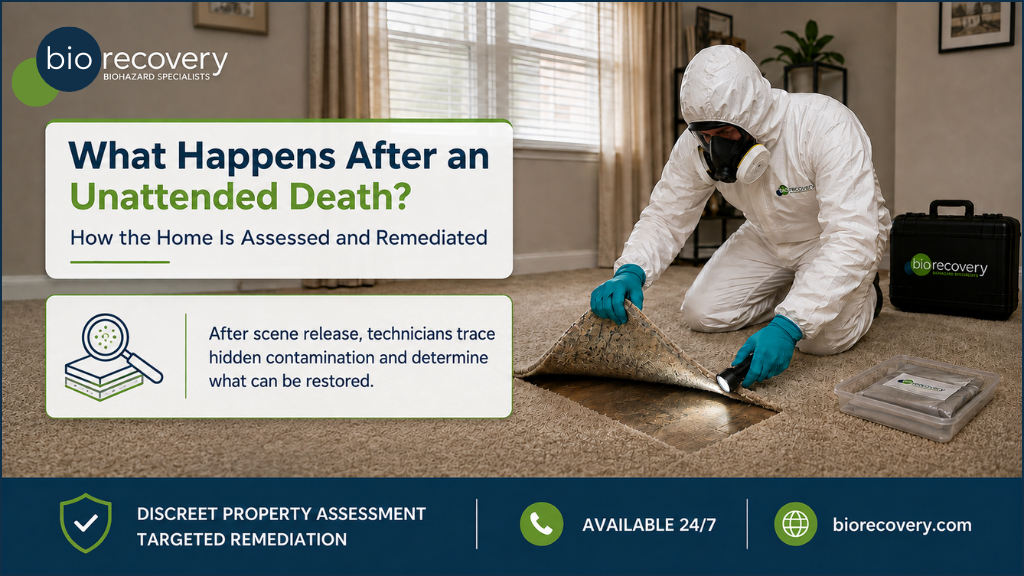
A professional assessment identifies where contamination is present, which materials require removal, and what can remain. The visible area provides the starting point, but fluid movement and the home’s construction determine the full scope.
Bio Recovery may inspect:
- Carpet, padding, flooring, and subflooring
- Mattresses or upholstered furniture
- Baseboards, drywall, cabinets, and fixtures
- Items stored beside or beneath the affected area
- Ceiling spaces below an upper-floor scene
- Nearby HVAC vents and air returns
- Routes used by occupants or emergency personnel
This inspection separates affected materials from safe property. It also prevents unnecessary removal based only on an item’s proximity to the scene.
Why Can Contamination Extend Beyond a Visible Stain?
Biological fluids can move through seams or absorbent layers before appearing on the exposed surface. A small carpet stain may cover a larger section of padding or subfloor underneath.
Fluid can also enter floor openings or reach a ceiling below an upper-level room. Technicians follow the path of the affected material rather than relying on surface appearance.
Odor can travel farther than fluid through hallways, doorways, or ventilation. Odor in another room does not prove that biological contamination reached it, but it can help identify areas that require evaluation.
What Determines the Remediation Scope?
The discovery delay matters, but it does not predict the property damage by itself. Indoor conditions and the materials surrounding the person also affect how far remediation must extend.
The main factors include:
- How long the person remained undiscovered
- Indoor temperature and humidity
- The surface beneath the person
- The amount and direction of fluid movement
- Openings between floors or building materials
- Ventilation and HVAC operation
- Insect activity
- Movement through the scene before it was secured
The relationship between time and property damage is not fixed. The conditions described in how long decomposition takes in a house show why two homes can experience different effects over the same number of days.
What Are the Steps Involved in Unattended Death Cleanup?
Unattended death remediation follows the contamination from its source into any affected materials. Each stage addresses a separate part of restoring the area.
| Stage | What Bio Recovery Does | Purpose |
|---|---|---|
| Assessment | Defines the affected area | Establishes the cleanup scope |
| Containment | Separates the work zone from clean spaces | Limits cross-contamination |
| Removal | Removes biological material and unsalvageable items | Eliminates the source |
| Cleaning and disinfection | Treats salvageable surfaces | Addresses surface contamination |
| Waste removal | Packages and removes contaminated waste | Prevents exposure during handling |
| Final review | Inspects and documents the completed work | Prepares the area for its next stage |
Containing the Work Area
Bio Recovery establishes controlled entry points before removal begins. Protective coverings and designated waste routes help prevent tools, footwear, or removed materials from carrying contamination into clean areas.
The containment setup depends on the building. A small room in a house requires a different approach from an apartment connected to common hallways or a commercial property with active occupants.
Removing Contamination and Unsalvageable Materials
Our technicians remove biological material and determine whether affected surfaces can be restored. The decision depends on whether cleaning products can reach the full depth of contamination.
Human blood can contain infectious microorganisms, including hepatitis B, hepatitis C, and HIV. OSHA’s Bloodborne Pathogens Standard establishes workplace controls for employees who may contact blood or other potentially infectious material.
Material construction often determines the appropriate response:
| Material | Main Concern | Common Response |
|---|---|---|
| Sealed tile or metal | Contamination remains on an intact surface | Clean and disinfect |
| Carpet and padding | Fluid can pass through both layers | Remove affected sections |
| Mattress or upholstery | Fluid can enter internal filling | Evaluate for removal |
| Subfloor or drywall | Fluid can enter pores or seams | Remove affected portions |
Bio Recovery removes only the material needed to reach the contamination. This targeted approach prevents hidden biological material from remaining without turning a contained cleanup into unnecessary demolition.
Cleaning and Disinfecting Salvageable Surfaces
Cleaning removes biological material and soil. Disinfection follows on compatible surfaces using a product approved for the intended organism and material.
The CDC’s procedures for blood and body-fluid contamination call for cleaning before disinfection. Remaining organic material can prevent a disinfectant from contacting the surface properly.
Bio Recovery follows product directions for application and contact time. The EPA’s current registered disinfectants for bloodborne pathogens identify products evaluated for use against HIV, hepatitis B, or hepatitis C.
Disinfection cannot correct contamination trapped inside absorbent material. Those materials require removal when the affected area cannot be reached and treated reliably.
Removing Contaminated Waste
Biohazardous material requires controlled packaging and disposal. Bio Recovery keeps affected waste separate from ordinary household debris and packages it to prevent leakage during handling.
Disposal requirements vary by state and waste category. Our nationwide teams follow the rules that apply where each property is located.
Treating Decomposition Odor
Odor treatment starts with removing its source. Air fresheners may temporarily cover a smell, but they cannot correct affected padding, subflooring, drywall, or furniture.
After removal and cleaning, Bio Recovery evaluates materials and air pathways that may retain odor. The treatment method depends on what remains in the property and where the odor traveled.
What Happens to Personal Belongings?
Not every item in the affected room must be discarded. Bio Recovery evaluates belongings according to their material, condition, location, and direct contact with contamination.
A sealed object stored inside an unaffected cabinet differs from exposed clothing or paper. Tell our team about photographs, legal documents, jewelry, and other important items before work begins.
Belongings may be:
- Safe to leave in place
- Moved so the surrounding area can be inspected
- Suitable for an available remediation process
- Contaminated beyond reliable restoration
- Set aside for discussion before a final decision
Proximity alone does not determine whether an item can remain. The ability to reach and address any contamination matters more.
What Documentation Can Bio Recovery Provide?
Cleanup documentation records the affected conditions and completed work. Insurers, estate representatives, landlords, or reconstruction contractors may use it to understand the project scope.
Records may include:
- A written assessment or estimate
- Photographs of relevant conditions
- Notes identifying removed materials
- An itemized invoice
- Applicable waste records
- A summary of completed work
You do not need to enter the scene to take insurance photographs yourself. Bio Recovery can document relevant conditions during the authorized assessment and remediation.
Insurance coverage depends on the policy and circumstances of the loss. Notify the carrier promptly and follow its instructions without assuming that cleanup or reconstruction will automatically qualify for coverage.
Read: How long professional biohazard cleanup takes
When Can Repair or Reoccupancy Begin?
Repair can begin after Bio Recovery completes the approved remediation scope. The property may still need replacement flooring, drywall, cabinets, or other finishes before the room returns to normal use.
An exposed subfloor or opened wall does not necessarily mean that cleanup remains unfinished. It may show that the affected section was removed and the area is ready for reconstruction.
Remediation and reconstruction solve different problems. Remediation addresses biological contamination, while reconstruction replaces building materials removed to reach it.
Key Takeaways
What happens after an unattended death involves separate investigation and property-remediation stages:
- Call 911, leave the immediate area, and avoid disturbing the scene.
- Wait until authorities release the property before arranging cleanup.
- Bio Recovery assesses visible damage and areas where contamination may be hidden.
- Materials are cleaned, remediated, or removed according to their condition.
- Documentation records the affected conditions and completed work.
- Repair or re-occupancy can move forward after the approved remediation is complete.
If an unattended death has affected your house, apartment, rental property, or commercial building, contact Bio Recovery. Our nationwide team is available 24/7 to assess the property, explain the required work, and complete the remediation with care and discretion.
Frequently Asked Questions
What are the first steps after discovering an unattended death?
Leave the immediate area, call 911, and keep other people and pets away. Do not touch the person, move nearby belongings, open windows, operate fans, or attempt to clean the scene.
Who should be contacted immediately for an unattended death investigation?
Call 911 so emergency personnel and local law enforcement can respond. Depending on the circumstances and local procedures, a medical examiner or coroner may then conduct the death investigation.
Who do I contact first when discovering an unattended death in a home?
Call 911 before contacting Bio Recovery, a funeral home, or the insurance carrier. Authorities must confirm the death, complete any required investigation, and release the home before remediation can begin.
What companies specialize in unattended death cleanup in the US?
Bio Recovery provides unattended death cleanup throughout the United States. Our nationwide teams assess contamination, remove affected materials, clean and disinfect salvageable surfaces, address decomposition odor, and document the completed remediation.