


INSURANCE FULLY COVERS MOST CLEANUPS
Bio Recovery Certifications & Technician Training


Bio Recovery Certifications & Technician Training
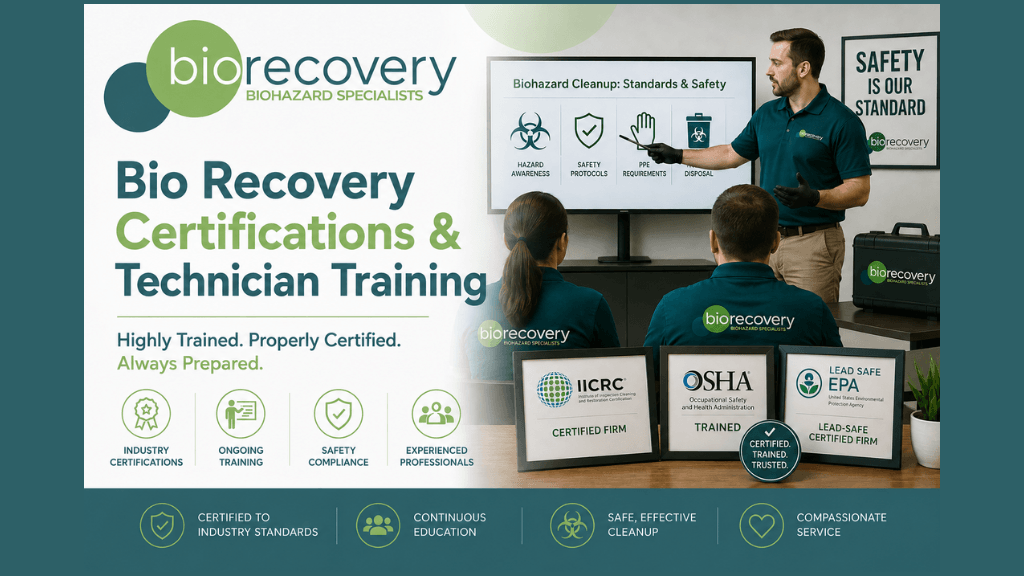
When you need professional biohazard cleanup, you want to know who is doing the work, how they are trained, and what qualifications support their work. At Bio Recovery, our technicians are trained and certified to perform specialized biohazard remediation, and our company maintains professional credentials and safety expertise relevant to the work we perform.
We publicly identify IICRC certification, an OSHA Outreach Instructor on staff, and EPA Lead-Safe Certified Firm status among our credentials. We also use established safety, cleaning, disinfection, containment, and waste-handling procedures when responding to biohazard situations.
Below, we explain what those credentials mean, how they relate to our work, and why they matter to our customers.
Our Credentials & Training at a Glance
|
Credential / qualification |
Issuing organization |
Relevant standard / area |
Bio Recovery role |
Current status |
Why it matters |
|
IICRC Certification |
Institute of Inspection Cleaning and Restoration Certification |
Professional cleaning/restoration industry standards |
Company/technician credential |
Publicly displayed by Bio Recovery |
Demonstrates professional certification within the cleaning and restoration industry |
|
OSHA Outreach Instructor |
OSHA Outreach Training Program |
Occupational safety and health |
Instructor on staff |
Publicly identified by Bio Recovery |
Gives our team in-house OSHA Outreach instructional expertise |
|
EPA Lead-Safe Certified Firm |
U.S. Environmental Protection Agency |
Lead Renovation, Repair and Painting requirements |
Company-level credential |
Publicly displayed by Bio Recovery |
Demonstrates qualification for covered lead-safe renovation activities |
|
Trained & certified technicians |
Bio Recovery / applicable training organizations |
Biohazard remediation and safety procedures |
Cleanup technicians |
Publicly stated by Bio Recovery |
Supports safe handling of blood, bodily fluids and other biohazards |
View our Biohazard Cleanup Services
A note about credential details: Some of our public pages display or identify credentials without publishing certificate numbers, individual certificate holders, issue dates, or expiration dates. We don't want to imply details that we haven't publicly documented. If you need verification of a particular credential, contact our team.
Are Bio Recovery Technicians Trained?
Yes. Our technicians are trained and certified to perform specialized biohazard cleanup and remediation.
Biohazard remediation isn't ordinary cleaning. Our technicians may work around blood, bodily fluids, potentially infectious materials, decomposition, crime scenes, contaminated materials and other hazards.
Our training and procedures are designed to help our teams safely:
- Assess affected areas
- Establish appropriate containment
- Use personal protective equipment
- Clean and disinfect contaminated surfaces
- Handle contaminated materials
- Manage biohazardous waste
- Minimize cross-contamination
- Address odors associated with biohazard incidents
- Restore affected areas when necessary
We describe our technicians as trained and certified throughout our service materials, including our crime-scene and commercial biohazard service information.
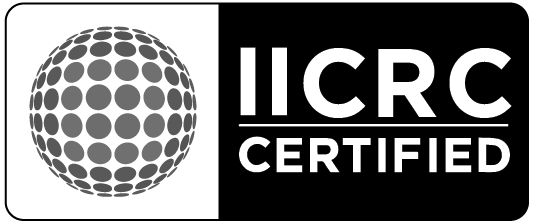
Our IICRC Certification
Credential
IICRC certification
Issuing organization
Institute of Inspection Cleaning and Restoration Certification (IICRC)
What is IICRC?
The IICRC is a professional organization that develops standards and certifications for professionals working in the cleaning, inspection and restoration industries.
Bio Recovery publicly displays an IICRC credential as part of our professional qualifications.
What does this mean for our customers?
IICRC certification is one part of the professional training and qualifications we use to support our remediation work.
It demonstrates participation in a recognized professional credentialing system within the cleaning and restoration industry.
For customers, that matters because biohazard remediation requires considerably more than making a contaminated surface look clean.
Our technicians need to understand the principles behind:
- Contamination
- Cleaning
- Restoration
- Safety
- Material removal
- Remediation
An important clarification
We don't want to overstate what the credential means.
Our public website currently identifies our IICRC credential, but does not provide the specific certification designation, certificate number, individual certificate holder or expiration date.
If you want to verify the exact IICRC credential associated with our team, contact Bio Recovery and we'll provide the information available for verification.
OSHA Expertise at Bio Recovery
Credential
OSHA Outreach Instructor on Staff
Organization
Occupational Safety and Health Administration (OSHA)
Relevant program
OSHA Outreach Training Program
We have an OSHA Outreach Instructor on staff, which we identify among our professional qualifications.
What does that mean?
The OSHA Outreach Training Program provides workers and employers with information about workplace hazards and ways to prevent workplace injuries and illnesses.
Having OSHA Outreach instructional expertise within our staff is particularly relevant to the work we perform because our technicians routinely encounter potentially hazardous environments.
Depending on the situation, biohazard cleanup can involve:
- Blood and bodily fluids
- Potentially infectious materials
- Chemicals
- Sharps
- Contaminated building materials
- Confined or restricted areas
- Other workplace hazards
Why does this matter to customers?
Our customers don't simply need someone who can clean.
They need a company that understands the safety considerations involved in entering and working in contaminated environments.
Our OSHA expertise is one part of the safety framework behind our work.
One important distinction
We do not describe ourselves as an "OSHA-certified biohazard cleanup company."
That's not an accurate description of what an OSHA Outreach Instructor credential means.
Instead, we identify the credential accurately:
OSHA Outreach Instructor on Staff
We believe precise language is important when customers are evaluating remediation companies.
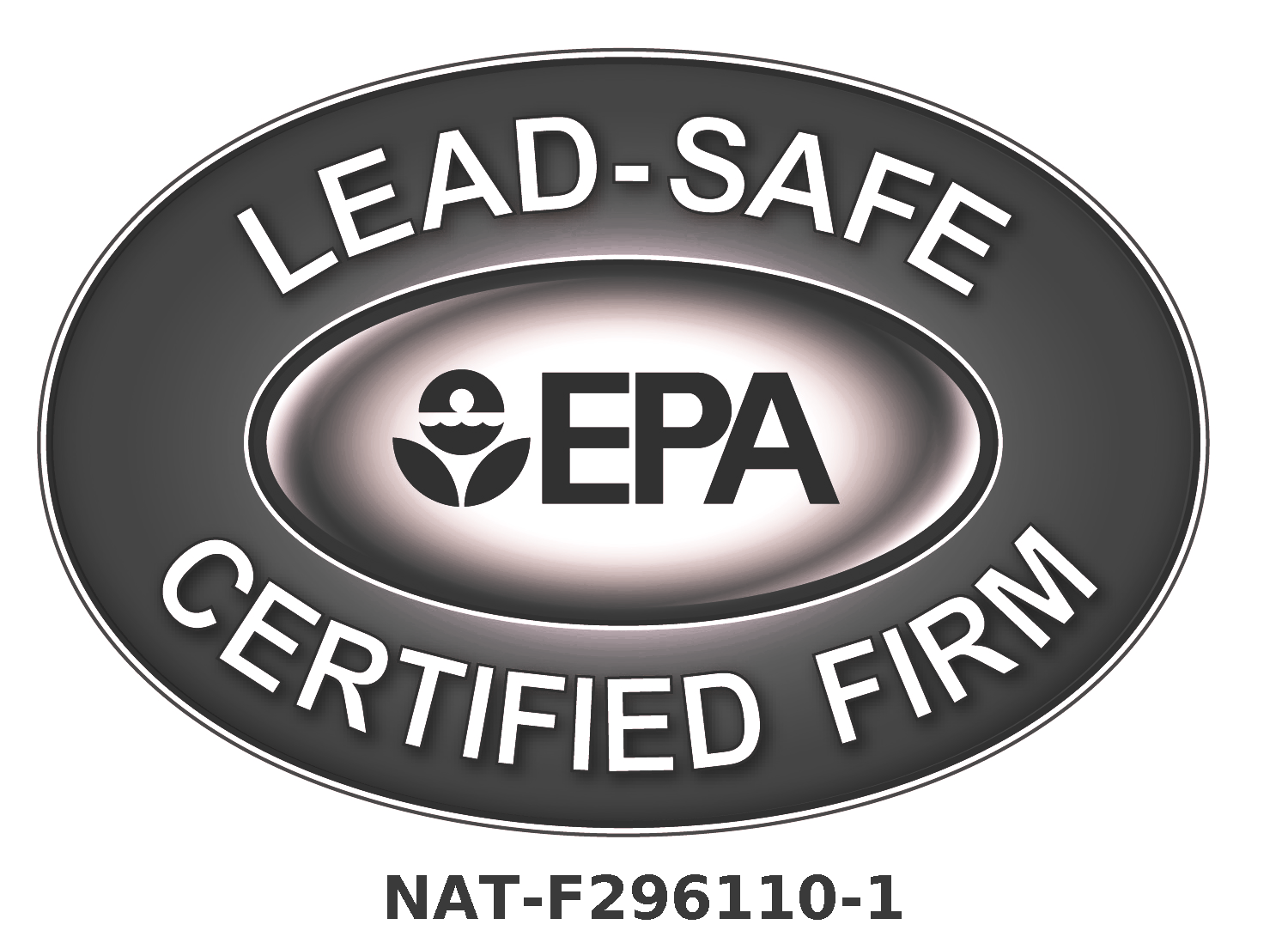
EPA Lead-Safe Certified Firm
Credential
EPA Lead-Safe Certified Firm
Issuing organization
U.S. Environmental Protection Agency (EPA)
Relevant standard
Renovation, Repair and Painting (RRP) Rule
Bio Recovery publicly displays an EPA Lead-Safe Certified Firm credential on our New York City crime-scene service page.
What does this certification mean?
EPA Lead-Safe certification applies to firms performing certain renovation, repair and painting activities involving lead-based paint.
It is particularly relevant to covered work in:
- Pre-1978 housing
- Child-occupied facilities
- Buildings where lead-based paint may be present
Why does it matter?
Some remediation projects can involve older structures and building materials.
Having lead-safe qualifications can therefore be relevant when a project involves work covered by EPA's lead-safe requirements.
What it does NOT mean
Our Lead-Safe Firm certification is not a general EPA certification for every type of biohazard cleanup we perform.
We believe it's important to distinguish the specific purpose of each credential.
Our Biohazard Cleanup Training
Our technicians perform work that requires specialized knowledge and procedures.
Depending on the assignment, our teams may work with:
Blood and bodily fluids
We understand the precautions required when potentially infectious biological materials are present.
Crime scenes
Our teams understand the specialized nature of cleaning and remediating areas following law-enforcement investigations and traumatic events.
Unattended deaths
Decomposition can create contamination and odor issues that require specialized remediation.
Suicides
These situations can involve blood and bodily-fluid contamination as well as significant emotional stress for families and property owners.
Infectious disease
Our teams use appropriate cleaning and disinfection procedures for affected environments.
Commercial biohazards
Businesses may require additional planning around employees, customers, operations, documentation and property access.
What Our Technicians Need to Know
Training is not simply about learning how to use cleaning products.
Our technicians need to understand the relationship between hazard identification, containment, PPE, cleaning, disinfection, material removal and waste disposal.
A typical remediation may involve:
- Assessing the scene
We identify the affected areas and determine the appropriate remediation approach.
- Establishing containment
We take steps to control the affected area and reduce the potential for cross-contamination.
- Using appropriate PPE
Our technicians use personal protective equipment appropriate to the work being performed.
- Removing contamination
We clean affected surfaces and remove materials that cannot appropriately be remediated.
- Disinfecting
We use appropriate disinfecting products and procedures for the contamination involved.
- Handling waste
Contaminated materials are handled and disposed of through appropriate biohazard-waste procedures.
- Addressing odors and restoration
Where necessary, we address persistent odors and coordinate the restoration of affected materials
The Standards and Procedures We Follow
Our credentials are only one part of how we approach biohazard remediation.
Our service information references and incorporates practices associated with:
- OSHA
- EPA
- CDC guidance
- Industry cleaning and restoration standards
- Appropriate PPE
- Containment
- Professional disinfection
- Biohazard waste handling
For commercial biohazard projects, for example, we describe the use of OSHA-compliant remediation procedures, EPA-registered disinfectants and appropriate hazardous-waste disposal procedures.
Learn About Our Commercial Biohazard Cleanup Process
Credentials vs. standards
There's an important difference between the two.
A certification is a credential held by a company or individual.
A standard or regulation is a framework that guides how work should be performed.
We don't consider references to OSHA, EPA or CDC guidance to be certifications. Instead, they're part of the regulatory, safety and technical framework relevant to our work.
Why Our Training Matters to You
When you hire Bio Recovery, you're not simply hiring someone to clean a room.
You're trusting us to enter an environment that may contain biological hazards and to help return that environment to a safe, usable condition.
Our training and credentials matter because they support our ability to:
Protect our technicians
Our employees need to understand the hazards they're encountering.
Protect occupants
Appropriate containment and remediation can help minimize the risk of contamination spreading to unaffected areas.
Handle contamination correctly
Biohazard cleanup requires specialized procedures that differ from ordinary residential or commercial cleaning.
Handle contaminated materials appropriately
Materials that cannot be safely restored need to be handled and disposed of properly.
Provide professional documentation
Property owners, families, businesses and insurance companies may need documentation of the remediation performed.
How We Approach Technician Training
We believe training should translate into better work on the job site.
That means our technicians need practical knowledge—not simply certificates on a wall.
Our approach centers on:
Safety → Assessment → Containment → Remediation → Disinfection → Waste Handling → Restoration
Every situation is different, so the exact procedures we use depend on:
- The type of incident
- The extent of contamination
- The materials affected
- The property
- The potential hazards
- Applicable requirements
How to Verify a Biohazard Cleanup Company's Credentials
If you're comparing Bio Recovery with another remediation company, we recommend asking every company the same questions.
Ask:
What certifications do your technicians hold?
Don't settle for a generic "we're certified."
Ask which certification.
Who issued the certification?
The issuing organization matters.
Who actually holds the credential?
A company credential and an individual technician credential aren't necessarily the same thing.
Is the credential current?
Ask about issue and expiration dates where applicable.
Does the certification apply to my situation?
A lead-safe credential, for example, isn't the same thing as a biohazard-remediation credential.
What training do your technicians receive?
Ask about the practical safety and remediation training behind the credential.
How do you handle biohazard waste?
A professional remediation company should be able to explain its waste-handling process.
Our Commitment to Transparency
We believe customers should be able to distinguish between:
What we're credentialed to do
and
what we claim to do.
That's why we don't want to lump every safety standard, training program, certification and regulatory reference into one generic statement that we're "fully certified."
Instead, we're building this page to explain the credentials and training we can substantiate.
Where a credential's detailed certificate information isn't publicly available, we're not going to invent it.
If you need specific verification before hiring us, contact our team and ask about the credential or training relevant to your situation.
Frequently Asked Questions
Facing an unexpected loss can be overwhelming, and questions about cleanup are common. We're here to provide answers and support, addressing all your concerns about after death cleaning services with care.
What certifications does Bio Recovery have?
Bio Recovery publicly identifies IICRC certification, an OSHA Outreach Instructor on staff, and EPA Lead-Safe Certified Firm status among its professional credentials. We also describe our technicians as trained and certified for biohazard cleanup.
Are Bio Recovery technicians trained?
Yes. Our technicians are trained and certified to perform specialized biohazard cleanup and remediation. Their work can involve blood and bodily fluids, crime scenes, unattended deaths, infectious disease, commercial biohazards and other potentially hazardous situations.
What is Bio Recovery's IICRC certification?
We publicly display an IICRC credential. The current public pages do not identify the specific IICRC designation, certificate number, individual holder or expiration date, so we do not claim details that aren't publicly documented.
Does Bio Recovery have OSHA training?
Yes. We have an OSHA Outreach Instructor on staff and reference OSHA-compliant procedures in our remediation services.
Is Bio Recovery OSHA certified?
We don't describe ourselves as an "OSHA-certified biohazard cleanup company." Our accurate credential description is OSHA Outreach Instructor on Staff.
Is Bio Recovery EPA certified?
Bio Recovery publicly displays an EPA Lead-Safe Certified Firm credential. This certification relates to covered lead-safe renovation activities and isn't a blanket certification for all of our biohazard services.
Why are certifications important for biohazard cleanup?
Credentials provide evidence of professional training and qualifications. They should be considered alongside a company's experience, safety procedures, insurance, waste-handling practices and ability to perform the specific remediation required.
What training do Bio Recovery technicians receive?
Our technicians are trained for specialized biohazard remediation, including safety procedures, PPE, containment, cleaning, disinfection, handling contaminated materials and biohazard-waste procedures.
Can I verify Bio Recovery's certifications?
Yes. If you need documentation or verification of a particular credential, contact Bio Recovery and ask our team about the credential relevant to your project.
Visit our FAQ page for more detailed information and answers to common questions. If you have specific concerns, don't hesitate to contact our team directly.
Need Professional Biohazard Cleanup?
If you're dealing with blood, bodily fluids, an unattended death, crime scene, suicide, infectious disease or another biohazard situation, Bio Recovery is available to help 24/7.
Our trained technicians can assess the situation, explain the remediation process and determine the appropriate next steps.
Related Bio Recovery Resources
- How to Choose a Biohazard Cleanup Company
- Biohazard Cleanup Step-by-Step
- Commercial Biohazard Cleanup
- Crime Scene Cleanup
- Pricing & Payments
- Bio Recovery vs. Bio-One
- Bio Recovery vs. Aftermath Services