



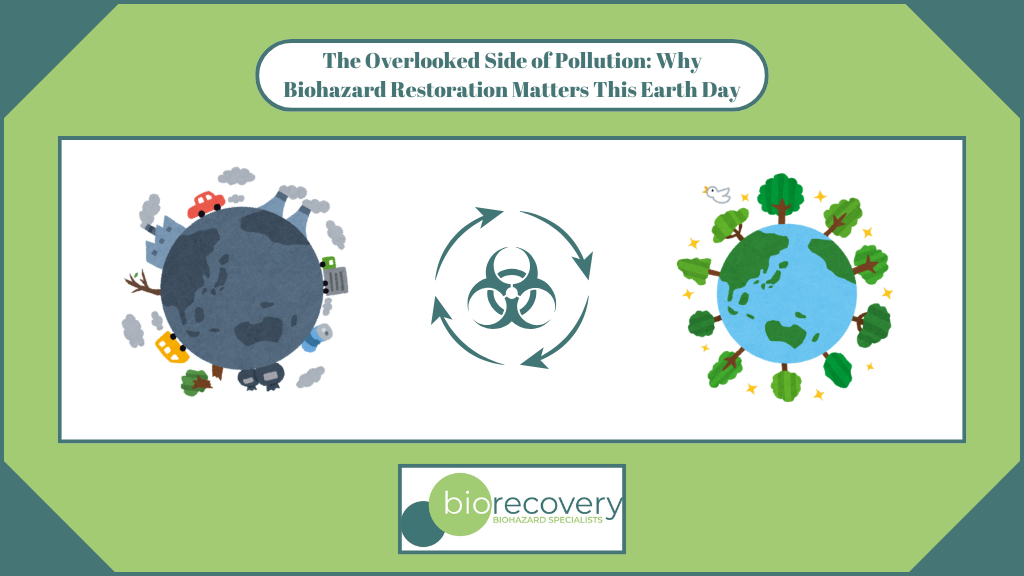
Pollution is often understood through what can be seen.
Plastic accumulation. Air pollution. Industrial waste.
These are the images most people associate with environmental damage. They are visible, measurable, and widely discussed.
But pollution does not always present itself that way.
Some forms develop quietly. They exist within contained environments. They spread through materials, move through air, and change over time. If they are not handled correctly, they do not stay contained.
This is where biohazard restoration becomes part of the environmental conversation.
Earth Day focuses on responsibility. Not just what is prevented—but what is managed correctly when conditions change. Pollution is not only about what builds up. It is also about what spreads.
For a closer look at how contamination is handled in real-world environments, Bio Recovery outlines the full scope of biohazard cleanup services.
Environmental Responsibility Starts at the Ground Level
Earth Day has shifted over time.
It is no longer just about global awareness. It is about what happens at a local level—inside homes, across properties, and within everyday environments.
The idea behind “Our Power, Our Planet” reflects that shift. Environmental impact is shaped by what people do in the spaces they directly control. You can see that emphasis on local action and shared responsibility in the Earth Day 2026 initiative.
What that actually means in practice
Environmental responsibility is not limited to prevention. It includes:
- Recognizing when an environment is compromised
- Taking action to contain contamination
- Preventing localized issues from expanding
This is where biohazard restoration aligns directly with Earth Day principles.
It is environmental responsibility in action.
Pollution Is Not Always Visible — And That Matters
Most environmental conversations center on what can be seen. But some of the most impactful forms of pollution are the ones that develop beneath the surface.
Biological contamination falls into that category.
It introduces organic material and microorganisms into spaces where they do not belong. These materials are not static. They respond to their environment and evolve over time.
Common forms of biological contamination
- Blood and bodily fluids
- Decomposition byproducts
- Human and animal waste
- Pathogen-contaminated materials
These are not just isolated hazards. They can affect air, surfaces, and structural materials simultaneously.
A different way to understand pollution
Instead of treating pollution as a single category, it helps to look at how it behaves:
| Type | Behavior | Impact Pattern |
| Traditional pollution | Builds over time | Gradual |
| Biological contamination | Spreads and evolves | Progressive |
This distinction is what makes biohazard restoration necessary.
It is not just removal but an interruption.
How Biological Contamination Affects Indoor Environments
Indoor environments are often overlooked in environmental discussions. But they are critical.
Air systems, materials, and structural components all interact in ways that allow contamination to move.
Biological contaminants can:
- Circulate through ventilation systems
- Absorb into porous materials
- Release particles into the air
- Persist long after initial exposure
This is not just theoretical. The way biological contaminants impact indoor air and surfaces is well documented in environmental health research, especially in how biological contaminants influence indoor air quality and environmental conditions.
Why this matters beyond the space itself
Indoor environments are not isolated.
Air moves. Materials degrade. Systems connect.
What begins in one area can extend into others if it is not properly contained.
Biohazard Restoration as Environmental Containment
Biohazard restoration exists to stop contamination before it spreads further.
It is structured, regulated, and designed to address both visible and hidden hazards.
The process follows a clear progression:
- Assess the extent of contamination
- Contain affected areas
- Remove hazardous materials
- Disinfect and neutralize
- Dispose of materials properly
Each step is intentional.
The outcome is not just a cleaned space
It is a controlled environment where:
- Contamination has been fully removed
- Air and surfaces are safe
- Further spread has been prevented
This directly reflects the same mindset behind environmental efforts—taking action to protect and stabilize environments.
When Contamination Becomes an Environmental Issue
Not all contamination stays contained.
Some situations develop over time. They begin to affect structural integrity, air quality, and surrounding environments.
This progression is what defines a Biohazard Disaster.
It is not a single event. It is the result of contamination that has been allowed to evolve.
Understanding how these situations develop adds important context to environmental risk.
Cleaning vs. Restoration: A Critical Distinction
There is a clear difference between cleaning and biohazard restoration.
| Cleaning | Biohazard Restoration |
| Focuses on appearance | Focuses on safety |
| Removes surface debris | Removes embedded contamination |
| Limited scope | Full environmental control |
The difference in simple terms
Cleaning addresses what is visible.
Biohazard restoration addresses what remains.
Time Changes the Impact of Contamination
Biological contamination develops in stages.
It does not stay in its original form.
Progression over time
- Initial stage: localized contamination
- Secondary stage: absorption and spread
- Advanced stage: environmental and structural impact
Why timing matters
The longer contamination remains:
- The deeper it spreads
- The harder it becomes to remove
- The greater the environmental impact
Biohazard Restoration interrupts that progression
It stops contamination before it extends further.
Earth Day in Practice: What Responsibility Actually Looks Like
Earth Day promotes action.
Not abstract action—practical action.
It emphasizes that environmental responsibility is ongoing. It is reflected in daily decisions and how environments are managed over time. That idea is reinforced through guidance that encourages people to carry Earth Day principles into everyday environmental habits and decisions.
Biohazard restoration fits directly into that mindset
It represents:
- Immediate response to environmental risk
- Responsible handling of hazardous materials
- Prevention of further environmental impact
It is not separate from environmental responsibility.
It is part of it.
What Happens Without Proper Biohazard Restoration
When biological contamination is not handled correctly, the impact expands.
The effects are layered:
Immediate:
- Ongoing microbial activity
- Persistent odor
- Continued exposure risk
Secondary:
- Spread into surrounding areas
- Material degradation
- Increased contamination depth
Environmental:
- Improper disposal affecting waste systems
- Broader exposure beyond the original site
- Increased strain on environmental infrastructure
Direct Answers to Common Questions
Is biological contamination considered pollution?
Yes. Biological contamination introduces harmful substances into environments and disrupts their normal state. Because it spreads and evolves, it meets the broader definition of pollution.
Why is biohazard restoration necessary instead of standard cleaning?
Standard cleaning focuses on surface-level removal. It does not eliminate contamination embedded in materials or neutralize pathogens. Biohazard restoration removes hazards at their source and prevents further spread.
Can contamination spread beyond one location?
Yes. It can move through air systems, porous materials, and contact. Without proper containment, it can extend into surrounding environments.
How does biohazard restoration connect to Earth Day?
Earth Day promotes environmental responsibility. Biohazard restoration reflects that responsibility by ensuring contamination is handled correctly and does not impact larger systems.
A More Complete View of Environmental Protection
Environmental protection is often framed as prevention.
Reducing waste. Limiting pollution. Avoiding harm.
But protection also includes response.
What happens after contamination occurs determines whether it stays contained or becomes something larger.
Biohazard restoration exists in that response phase.
Key Takeaways → Where This All Connects
Pollution is not always visible. And it is not always immediate.
Some of the most impactful forms develop quietly and evolve over time.
- Environmental responsibility includes both prevention and response
- Biological contamination behaves differently than traditional pollution
- Indoor environments are part of larger environmental systems
- Proper handling determines whether contamination spreads or stops
- Biohazard restoration supports the same environmental outcomes Earth Day was built around
This is where the connection becomes clear.
Earth Day highlights protecting the environment.
Biohazard restoration is one of the ways that protection is carried out in real-world conditions.
Moving Forward
Environmental responsibility is reflected in how situations are handled—not just how they are prevented.
Biohazard restoration is a controlled, informed response to contamination. It protects both immediate environments and the systems connected to them.
For situations that require professional evaluation or support, contact Bio Recovery.
Clean environments are not always the result of what is prevented.
They are often the result of what is properly restored.