



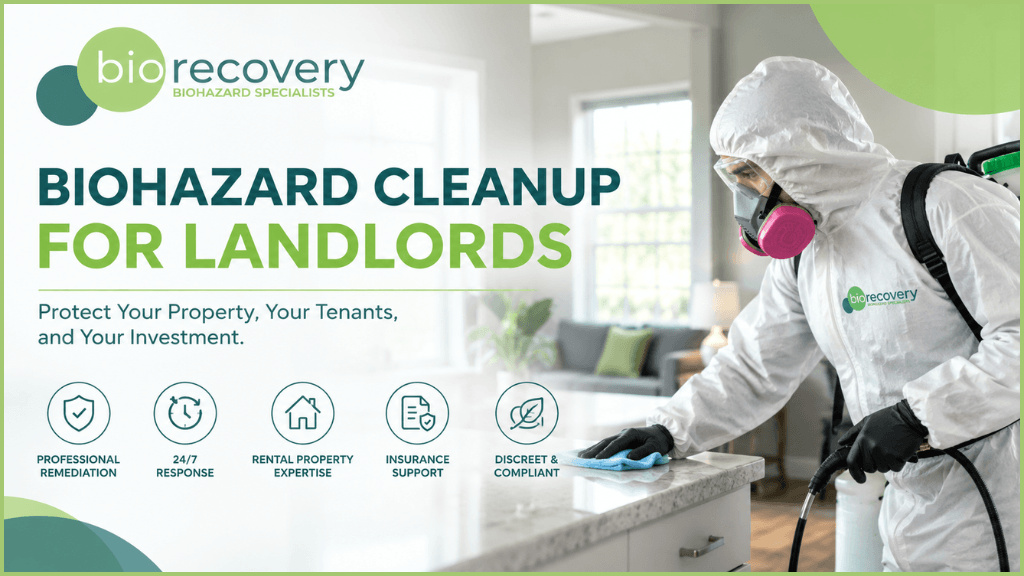
Professional Biohazard Remediation for Rental Properties
When a death, crime, blood spill, suicide, unattended death, or other biohazard incident occurs in a rental property, landlords have to deal with more than the contamination itself. You may also need to coordinate access, insurance, documentation, repairs, tenant communication, and getting the property ready for its next appropriate use.
Bio Recovery provides professional biohazard cleanup for landlords and rental property owners 24/7.
We handle the specialized remediation while you remain focused on managing your property.
Call Bio Recovery 24/7: 1-888-752-5001
What Should a Landlord Do When a Biohazard Incident Happens?
If a biohazard incident occurs in one of your rental properties:
1. Keep people away from the affected area
Don’t allow tenants, maintenance workers, contractors, or other unauthorized people into an area where blood, bodily fluids, decomposition, or other potentially infectious material may be present.
2. Don’t send maintenance staff to clean it
Biohazard remediation is different from ordinary property maintenance.
OSHA’s Bloodborne Pathogens Standard addresses occupational exposure to blood and other potentially infectious materials and includes requirements concerning PPE, housekeeping, decontamination, and regulated waste.
3. Determine whether authorities are involved
If the incident involves a death, suspected crime, or other situation requiring investigation, wait for the appropriate authorities to release the scene before remediation begins.
4. Contact Bio Recovery
Tell us:
- What happened
- Where it happened
- When it was discovered
- Whether anyone has entered the area
- Whether authorities have released the scene
- What type of property is involved
We’ll help you understand the next step.
5. Contact your insurer
Ask whether your policy provides coverage for the specific incident and what documentation your carrier requires.
6. Document the incident
Keep records of:
- Date and time
- Property address
- Incident type
- Notifications
- Insurance information
- Cleanup company
- Remediation performed
- Restoration required
What Types of Biohazard Cleanup Do Landlords Need?
Bio Recovery works with landlords dealing with a wide range of situations.
Unattended Deaths
A tenant may die inside a rental property and remain undiscovered for an extended period.
Decomposition can result in biological contamination, affected materials, and odor requiring specialized remediation.
Learn about unattended death cleanup →
Crime Scene Cleanup
A rental property may require remediation following a homicide, assault, suicide, or other traumatic event.
Law enforcement investigates the scene; professional remediation addresses the biological contamination that remains afterward.
Learn about crime scene cleanup →
Blood & Bodily Fluid Cleanup
Accidents, injuries, overdoses, and other incidents can leave blood or bodily fluids inside a rental unit.
Suicide Cleanup
A suicide in a rental property can leave biological contamination requiring specialized remediation.
Hoarding & Severe Property Contamination
A tenant move-out may reveal extensive waste, biological contamination, odors, pests, or other conditions requiring more than conventional turnover cleaning.
Learn about hoarding cleanup →
Landlord Biohazard Cleanup Is Not the Same as Rental Turnover Cleaning
A landlord may already have a cleaning company, maintenance team, or property-management company.
Those services can be appropriate for:
- Routine cleaning
- Painting
- Carpet cleaning
- Trash removal
- Repairs
- Standard turnover
But a property contaminated with blood, bodily fluids, decomposition, or other potentially infectious materials presents a different type of problem.
Professional remediation can involve:
Assessment → Containment → PPE → Cleaning → Disinfection → Material Removal → Waste Handling → Documentation
OSHA specifically addresses occupational exposure to blood and other potentially infectious materials, including controls, PPE, housekeeping, and contaminated-waste handling.
That’s why we recommend that landlords not treat a biohazard incident as a routine maintenance job.
Should a Landlord Send Maintenance Staff to Clean Blood?
We don’t recommend treating blood or other potentially infectious material as a routine maintenance task.
The appropriate requirements depend on the circumstances and the worker’s occupational exposure.
OSHA explains that employers must determine which job classifications or tasks involve occupational exposure, and its Bloodborne Pathogens Standard establishes requirements where the standard applies.
For landlords, the practical question is simple:
Do you want your maintenance employee handling a situation that requires specialized biohazard remediation?
For significant contamination, professional remediation provides a specialized alternative to asking maintenance personnel to handle the cleanup.
What Does Biohazard Cleanup for a Rental Property Involve?
At Bio Recovery, our process can include:
Assessment
We evaluate the affected area and determine the likely scope of remediation.
Containment
Where appropriate, we establish controls designed to prevent contamination from spreading.
PPE & Safety Procedures
Our technicians use protective equipment appropriate to the work being performed.
Cleaning & Disinfection
We clean and disinfect affected surfaces using procedures appropriate to the contamination.
Contaminated Material Removal
Materials that cannot be appropriately remediated may require removal.
Odor Remediation
When decomposition or other biological contamination creates persistent odors, additional remediation may be required.
Waste Handling
Contaminated materials are handled and disposed of using appropriate procedures.
Documentation
We document the work performed and can provide information relevant to your property records and insurance process.
Bio Recovery’s existing service information describes documentation, material removal, testing, repeated inspections, sanitization, and biohazard-waste handling as components of its remediation process.
See the complete Biohazard Cleanup Process →
What Happens to the Rental Property After Cleanup?
This is one of the biggest concerns for landlords.
Does the entire apartment need to be renovated?
Not necessarily.
The answer depends on:
- Where contamination occurred
- How far it spread
- Whether porous materials were affected
- How long contamination was present
- Whether materials can be appropriately cleaned
- Whether flooring or structural materials require removal
At Bio Recovery, our objective is to remediate the affected areas rather than unnecessarily replace unaffected property.
Some materials may be cleaned and disinfected.
Others may need to be removed and replaced.
If additional restoration is necessary, we’ll identify the issues so you can coordinate the next stage.
How Long Does Biohazard Cleanup Take in a Rental Property?
There isn’t one standard timeline.
A small, contained blood cleanup may take several hours, while an unattended death involving decomposition and contaminated flooring or structural materials can take considerably longer.
Factors include:
- Type of incident
- Size of affected area
- Extent of contamination
- Time before discovery
- Materials affected
- Odor
- Required material removal
- Property access
See our complete guide to how long biohazard cleanup takes →
This is an important link because the landlord page should answer the question briefly without trying to become the site’s primary timeline resource.
How Much Does Biohazard Cleanup Cost for a Landlord?
There is no universal price for rental-property biohazard remediation.
The cost can depend on:
| Factor | Why It Matters |
| Type of incident | Different situations require different remediation |
| Size of affected area | More area can mean more labor and materials |
| Contamination severity | More extensive contamination may require additional work |
| Time before discovery | Decomposition can increase remediation requirements |
| Porous materials | Some materials may require removal |
| Odor remediation | Decomposition-related odors can require additional treatment |
| Material removal | Removal and disposal add to project scope |
| Waste handling | Biohazardous materials require specialized handling |
| Property access | Access can affect equipment and logistics |
Bio Recovery’s pricing page explains that estimates consider factors including the type of incident, time between death or trauma and discovery, amount of material requiring special handling, and access for vehicles and dumpsters.
Read our Biohazard Cleanup Cost Guide →
Will Insurance Pay for Biohazard Cleanup in a Rental Property?
It depends on the policy and circumstances.
Landlords should not assume that a particular incident is covered—or excluded—without reviewing the applicable policy.
Contact your insurance carrier and ask:
- Is biohazard remediation covered?
- Is this specific incident covered?
- What deductible applies?
- Is emergency mitigation authorized?
- Does the insurer require a particular remediation company?
- What documentation is required?
- Are building materials covered?
- Are contents covered?
- Is there a difference between the landlord’s policy and the tenant’s policy?
Bio Recovery can provide documentation relating to the remediation work, but insurance coverage is determined by the applicable policy and insurer.
Our existing pricing and payments information explains that Bio Recovery can work with insurance carriers and provide documentation associated with the claim.
Learn more about Bio Recovery pricing and payments →
Who Pays for Biohazard Cleanup in a Rental Property?
There isn’t a universal answer.
Responsibility for payment can depend on:
- The lease
- The insurance policy
- The type and cause of the incident
- State and local law
- The parties involved
- Whether a third party may be responsible
Because these issues can involve legal and contractual questions, Bio Recovery does not determine legal responsibility between a landlord, tenant, family member, insurer, or another party.
Our role is to perform the remediation and provide documentation relating to the work.
If you have a legal question about responsibility, consult qualified legal counsel in the applicable jurisdiction.
What If the Tenant Died in the Rental Property?
A tenant death can create several separate issues for a landlord:
- The scene may need to be released by authorities.
- The affected area may require professional remediation.
- The property may require additional restoration.
- Insurance may need to be notified.
- Personal property may need to be addressed separately.
- The landlord may need to coordinate access and contractors.
- Local legal requirements may apply before the property is rented again.
Bio Recovery handles the biohazard remediation portion of that process.
We don’t determine inheritance rights, tenant-property rights, disclosure obligations, or other legal matters.
What About the Tenant’s Belongings?
This is an important distinction.
Biohazard remediation and personal-property handling are not necessarily the same thing.
Depending on the circumstances, contaminated belongings may need to be:
- Assessed
- Cleaned
- Remediated
- Removed
- Disposed of
But landlords should not assume they can simply discard a deceased tenant’s possessions.
Property ownership, estate rights, lease provisions, and local law can affect what happens to personal belongings.
If you’re unsure, obtain appropriate legal guidance before disposing of property.
Bio Recovery can address contaminated materials that fall within the remediation scope, but we do not determine ownership or legal rights to a tenant’s belongings.
Preparing a Rental Property for the Next Tenant
After the biohazard remediation is complete, landlords may still have additional work.
Depending on the condition of the property, that could include:
- Flooring replacement
- Drywall repair
- Painting
- Plumbing repair
- Electrical work
- HVAC work
- Odor-related restoration
- General turnover cleaning
- Appliance replacement
- Furniture removal or replacement
The important distinction is:
Biohazard remediation
Addresses the biological contamination.
Restoration
Addresses damage or building materials that require repair or replacement.
Turnover cleaning
Prepares the property for its next occupant.
These can be three separate stages.
Documentation Landlords Should Keep
We recommend maintaining a complete record of the incident and remediation.
Depending on the situation, this may include:
- Date of incident
- Date discovered
- Property address
- Incident description
- Police/authority information
- Insurance claim information
- Remediation estimate
- Scope of work
- Photographs
- Invoices
- Disposal documentation
- Final inspection information
- Restoration invoices
Bio Recovery documents its remediation work and says photographs and documentation can be provided for insurance and administrative purposes.
This documentation can also help you maintain an accurate property record.
Discreet Biohazard Cleanup for Rental Properties
A biohazard incident can attract unwanted attention in a rental community.
Neighbors may see:
- Cleanup crews
- Equipment
- Contractors
- Property staff
- Emergency responders
We understand that landlords may want the situation handled as discreetly as possible.
Bio Recovery states that its technicians arrive in nondescript white vans and emphasizes discretion throughout the remediation process.
Our goal is to perform the work professionally without creating unnecessary attention.
What Landlords Should Ask a Biohazard Cleanup Company
Before hiring a remediation company, ask:
Experience
- Have you handled rental properties before?
- Have you handled unattended deaths?
- Do you handle crime scenes?
- Do you handle blood and bodily fluids?
Training
- How are technicians trained?
- What certifications does the company hold?
- What safety procedures are used?
Scope
- What areas will you inspect?
- How do you identify affected materials?
- What materials may need removal?
- Is odor remediation included?
Documentation
- Will I receive an estimate?
- Will the work be documented?
- Can you provide photographs?
- Can you provide an itemized invoice?
Insurance
- Do you work with insurance companies?
- What information will you provide for my claim?
- What should I ask my insurer?
Property access
- How do you coordinate keys and access?
- Can you work with my property manager?
- How do you maintain discretion?
Manage properties for owners? See our guide to Biohazard Cleanup for Property Managers.
Bio Recovery’s own guide to choosing a cleanup company recommends asking about training, credentials, safety procedures, waste disposal, experience, scope of work, response time, insurance assistance, and documentation.
Read our complete guide: How to Choose a Biohazard Cleanup Company →
Bio Recovery for Landlords
At Bio Recovery, we understand that you’re not calling us because you want another cleaning vendor.
You’re calling because something has happened at your property that requires specialized remediation.
Our role is to help you:
- Understand what needs to happen
- Control access to the affected area
- Assess the contamination
- Remediate affected areas
- Handle contaminated materials
- Document the work
- Coordinate with insurance when applicable
- Identify additional restoration needs
We provide 24/7 biohazard remediation for rental properties and other residential and commercial environments.
Bio Recovery’s Training & Credentials
When someone enters your rental property to handle biological contamination, their training matters.
Bio Recovery publicly identifies:
- IICRC credentials
- An OSHA Outreach Instructor on staff
- EPA Lead-Safe Certified Firm status
- Trained and certified biohazard cleanup technicians
The company has a dedicated page explaining the credentials and training it publicly documents.
See Bio Recovery Certifications & Technician Training →
Landlord Biohazard Cleanup Checklist
When a biohazard incident occurs:
☐ Restrict access to the affected area
☐ Don’t send maintenance staff into significant contamination
☐ Contact appropriate authorities when necessary
☐ Wait for official scene release when applicable
☐ Contact Bio Recovery
☐ Notify your insurance carrier
☐ Document the incident
☐ Arrange professional remediation
☐ Keep remediation records
☐ Identify any required restoration
☐ Address tenant/property issues separately
☐ Verify applicable legal requirements before re-renting
Frequently Asked Questions
What should a landlord do after a tenant dies in a rental property?
Secure the affected area, allow authorities to complete any required investigation, contact a professional biohazard remediation company, notify the appropriate insurer, and document the incident. Legal requirements concerning the tenant’s belongings, disclosures, or re-rental can vary by jurisdiction.
Does a landlord have to clean up blood in a rental property?
The appropriate response depends on the circumstances and applicable law. For significant blood or bodily-fluid contamination, professional biohazard remediation is appropriate rather than treating the incident as ordinary property maintenance.
Can a landlord send a maintenance worker to clean a biohazard?
Landlords should carefully consider occupational-exposure requirements before assigning employees to biohazard cleanup. OSHA’s Bloodborne Pathogens Standard establishes requirements where employees have occupational exposure to blood or other potentially infectious materials.
Does landlord insurance cover biohazard cleanup?
It may, depending on the policy and circumstances. Coverage should be confirmed directly with the applicable insurer.
Who pays for biohazard cleanup in a rental property?
There is no universal answer. Payment responsibility can depend on the insurance policy, lease, circumstances of the incident, applicable law, and other factors.
How much does rental-property biohazard cleanup cost?
There is no fixed price. Costs depend on factors including contamination severity, affected materials, property size, time before discovery, material removal, disposal, and remediation requirements.
How long does biohazard cleanup take in a rental property?
A small, contained cleanup may take several hours, while more extensive contamination can take one or more days. The timeline depends on the type and extent of contamination and the materials affected.
Can Bio Recovery work with my property manager?
Yes. Landlords can coordinate with their property-management company while Bio Recovery handles the specialized remediation.
Will Bio Recovery document the cleanup?
Bio Recovery states that it photographs and documents remediation work and can provide documentation for insurance and administrative purposes.
Can the property be rented again immediately after cleanup?
Not necessarily. Biohazard remediation may be complete while additional restoration, repairs, or other property-related requirements remain. Landlords should also determine whether any jurisdiction-specific requirements apply before re-renting.
Need Biohazard Cleanup at a Rental Property?
If you’re a landlord dealing with a death, crime, blood contamination, unattended death, suicide, or another biohazard incident, Bio Recovery can help you understand the remediation process and next steps.
We’re available 24/7.
Call Bio Recovery