


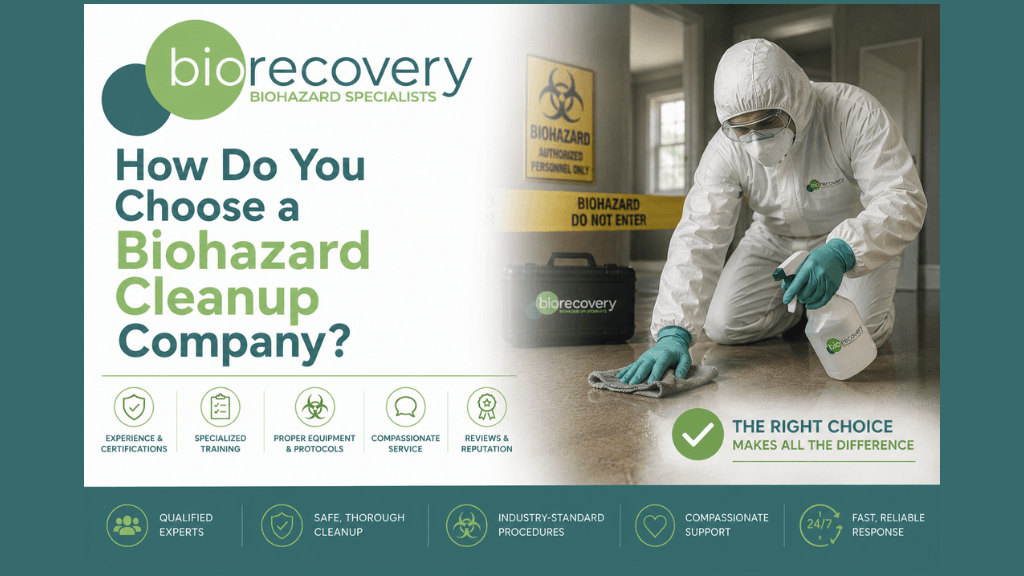
Choose a biohazard cleanup company based on training and credentials, safety procedures, response availability, experience with your specific type of incident, insurance and documentation support, proper waste disposal, and the company’s reputation. The lowest estimate is not necessarily the best choice when biological contamination is involved; the company should be able to explain how it will safely assess, contain, clean, disinfect, document, and restore the affected property.
Bio Recovery provides 24/7 biohazard remediation, with trained technicians, professional equipment, and procedures designed around applicable OSHA, EPA, and DEC requirements.
What Should You Look for in a Biohazard Cleanup Company?
When comparing remediation companies, focus on these 10 factors.
| Factor | What to Look For |
| Experience | Established experience handling biohazard and trauma scenes |
| Training | Technicians trained for biological hazards and remediation |
| Certifications | Relevant industry credentials and training |
| Safety procedures | PPE, containment, disinfection, and contamination-control procedures |
| Waste disposal | Proper handling and disposal of biohazardous materials |
| Availability | 24/7 emergency response when appropriate |
| Insurance assistance | Help documenting the loss and navigating the claim |
| Scope of work | Clear explanation of what will and won’t be remediated |
| Privacy | Discreet response and respect for occupants and families |
| Reputation | Reviews, testimonials, institutional relationships, and verifiable experience |
1. Verify the Company’s Training and Credentials
Biohazard remediation isn’t ordinary cleaning.
Technicians may encounter blood, bodily fluids, pathogens, contaminated materials, sharps, decomposition, or other potentially hazardous conditions.
Ask:
- What training do technicians receive?
- What certifications does the company hold?
- Is the company insured?
- Does it maintain appropriate safety training?
- What industry standards does it follow?
- Who supervises the remediation?
Bio Recovery currently identifies IICRC credentials and an OSHA Outreach Instructor on staff among its industry credentials.
Don’t stop at a badge
A good question is:
“What does that certification or training mean for the work being performed at my property?”
A reputable company should be able to explain its credentials rather than simply display logos.
2. Ask How the Company Handles Contamination
A professional remediation company should be able to explain its process before work begins.
A typical professional assessment should consider:
- Where contamination is visible
- Where contamination may have spread
- Porous versus nonporous materials
- Potential cross-contamination
- Odor
- Airborne contamination concerns
- Materials requiring removal
- Areas requiring disinfection
- Restoration requirements
Bio Recovery describes a process that includes zoning the property, using PPE, specialized air-control equipment, disinfectants, containment methods, and cleaning of both visible and unseen contaminated surfaces.
Ask:
“How do you determine the full extent of contamination?”
The answer should go beyond:
“We’ll clean what we can see.”
3. Make Sure They Understand Biohazard Waste Disposal
Cleaning isn’t finished when contaminated material has been removed from a room.
The company should have a process for:
- Containment
- Packaging
- Transportation
- Disposal
- Documentation
Ask:
“How do you handle and dispose of contaminated materials?”
This is particularly important when the cleanup involves blood, bodily fluids, sharps, contaminated flooring, or other regulated materials.
4. Look for Experience With Your Specific Situation
Not every biohazard cleanup is the same.
A company that handles blood cleanup may also have experience with:
- Crime scenes
- Homicides
- Suicides
- Unattended deaths
- Decomposition
- Infectious disease
- Hoarding
- Vehicle biohazards
- Commercial incidents
- Hazardous materials
Bio Recovery’s current service portfolio includes crime scene cleanup, blood cleanup, disease disinfection, unattended death cleanup, vehicle blood cleanup, suicide cleanup, hoarding cleanup, hazmat cleanup, and decomposition/odor services.
Ask:
“How many situations like mine has your company handled?”
Specific experience matters because the remediation requirements can vary substantially from one incident to another.
5. Confirm 24/7 Availability if You Need Emergency Service
Biohazard incidents don’t necessarily happen during business hours.
If the property requires immediate remediation, determine:
- Is someone available 24/7?
- Is the phone answered by a person?
- How quickly can a crew respond?
- Does the company operate in your area?
- Can they respond after law enforcement releases a scene?
Bio Recovery advertises 24/7 emergency response and says its teams can often begin responding within hours.
Important distinction
24/7 phone answering isn’t necessarily the same as 24/7 field response.
Ask specifically about the expected response time for your location.
6. Ask What Happens During the Initial Assessment
Before remediation begins, you should understand what the company intends to do.
A good assessment should establish:
- What happened
- Where contamination is located
- What materials are affected
- What can be cleaned
- What must be removed
- What equipment will be required
- What the anticipated timeline is
- What restoration may be necessary
Bio Recovery says technicians inspect the site and create a customized cleanup plan based on the circumstances and applicable guidelines.
7. Get a Clear Scope of Work
Don’t compare companies based solely on the dollar amount at the bottom of an estimate.
Two companies can quote different amounts because they’re proposing different scopes of work.
Ask whether the estimate explains:
- Labor
- Equipment
- Disinfection
- Material removal
- Disposal
- Odor remediation
- Structural remediation
- Restoration
- Documentation
The better question isn’t:
“Who is cheapest?”
It’s:
“What exactly am I getting for this price?”
8. Ask About Insurance Before You Sign Anything
Insurance may cover some biohazard remediation expenses depending on the policy and circumstances.
Ask the cleanup company:
- Do you work with insurance companies?
- Can you provide an itemized estimate?
- Will you document affected materials?
- Can you provide invoices and remediation documentation?
- What information will I need for my claim?
At Bio Recovery we work directly with insurance companies on your behalf to help customers navigate payment and claims.
Related resources
Is Crime Scene Cleanup Covered by Insurance?
9. Look for Discreet, Compassionate Service
Technical competence isn’t the only consideration.
Crime scenes, unattended deaths, suicides, and other traumatic events can be extremely difficult for families, employees, property managers, and business owners.
Ask whether the company provides:
- Discreet vehicles
- Professional communication
- Respect for privacy
- Compassionate coordinators
- Clear explanations
- Minimal disruption to occupants
Bio Recovery specifically describes its response as discreet and emphasizes compassionate support alongside technical remediation.
10. Check Independent Reputation and Experience
Don’t rely exclusively on testimonials published by the company.
Look for:
- Google reviews
- Better Business Bureau
- Independent reviews
- Government or institutional references
- News coverage
- Industry organizations
- Case studies
- Customer testimonials
Bio Recovery currently displays an A+ BBB rating on its contact page and has customer testimonials covering residential and commercial situations.
Independent government resources can also provide useful corroboration. For example, Chester County’s Office of the Coroner lists Bio Recovery Specialists among biohazard cleanup providers alongside other remediation companies.
Biohazard Cleanup Company Comparison Checklist
Before hiring a company, ask:
Credentials
- Is the company properly insured?
- Are technicians trained for biohazard remediation?
- Does the company have relevant certifications?
- Can the company explain those credentials?
Safety
- What PPE will technicians use?
- How will contamination be contained?
- How will affected materials be handled?
- How will the area be disinfected?
- How is biohazard waste disposed of?
Experience
- Have they handled this type of incident before?
- Do they handle structural remediation?
- Do they handle odor remediation?
- Do they work with residential and/or commercial properties?
Response
- Are they available 24/7?
- How quickly can they respond?
- Are their technicians local or dispatched from elsewhere?
Financial
- Will they provide a written estimate?
- Is the scope of work itemized?
- Do they work with insurance?
- Can they provide documentation for a claim?
- What expenses may not be included?
Reputation
- Can you find independent reviews?
- Does the company have credible third-party references?
- Are testimonials specific and verifiable?
- Does the company have experience with organizations like yours?
Bio Recovery vs. Other Biohazard Cleanup Companies
There isn’t one biohazard cleanup company that’s automatically right for every situation.
The best choice depends on:
- Your location
- The type of incident
- Required response time
- Property type
- Remediation scope
- Insurance requirements
- Experience
- Credentials
- Budget
Bio Recovery has created detailed comparison resources for several companies, allowing customers to evaluate differences rather than relying solely on generic claims.
Compare Bio Recovery With Trauma Services
Bio Recovery vs. Trauma Services
Use this comparison when you’re evaluating Bio Recovery against Trauma Services for biohazard and trauma remediation.
Compare Bio Recovery With Bio-One
This comparison can help customers understand differences between Bio Recovery and Bio-One before requesting service.
Compare Bio Recovery With Valor Technical Cleaning
Bio Recovery vs. Valor Technical Cleaning
This is particularly useful when you’re comparing specialized biohazard remediation providers.
Compare Bio Recovery With Aftermath Services
Bio Recovery vs. Aftermath Services
Aftermath is another established biohazard remediation provider offering crime scene, unattended death, suicide, commercial, and other remediation services.
Questions to Ask Before Hiring a Biohazard Cleanup Company
If you only have time to ask a few questions, start here.
1. Are you trained and certified for biohazard remediation?
2. Are you licensed and insured?
3. Have you handled this specific type of incident before?
4. How will you determine what areas are contaminated?
5. What materials will you remove?
6. How do you disinfect the affected area?
7. How do you dispose of biohazardous waste?
8. How quickly can you respond?
9. Will you work with my insurance company?
10. Will I receive documentation of the work?
11. What is included in your estimate?
12. Are there circumstances that could cause the final cost to increase?
A reputable company should be comfortable answering these questions clearly.
Red Flags When Choosing a Biohazard Cleanup Company
Be cautious if a company:
❌ Treats biohazard cleanup like ordinary house cleaning
Biological contamination requires specialized procedures and equipment.
❌ Won’t explain its remediation process
You should generally understand what will happen before work begins.
❌ Gives an unusually low estimate without inspecting the property
The cheapest estimate may not include the same scope of work.
❌ Can’t explain waste disposal
Ask specifically how contaminated materials are packaged, transported, and disposed of.
❌ Has no verifiable credentials or insurance information
Professional remediation companies should be able to explain their qualifications.
❌ Pressures you to make a decision immediately
You may be dealing with an emergency, but you still deserve clear information about the proposed work.
❌ Makes guarantees about insurance coverage
No remediation company should promise that an insurer will approve a claim without reviewing the policy.
What Should a Biohazard Cleanup Estimate Include?
A professional estimate should ideally make the scope understandable.
Depending on the project, it may include:
| Estimate Component | What It Tells You |
| Assessment | What areas were evaluated |
| Labor | Technician time |
| PPE | Protective equipment required |
| Containment | How contamination will be controlled |
| Cleaning | Cleaning/remediation work |
| Disinfection | Decontamination procedures |
| Material removal | What must be discarded |
| Disposal | Handling of contaminated waste |
| Odor remediation | Treatments required |
| Restoration | Repairs following remediation |
| Documentation | Records for owner/insurer |
The exact structure will vary by company and incident.
How Much Does Biohazard Cleanup Cost?
There is no universal price for biohazard remediation.
Costs can vary based on:
- Type of contamination
- Size of the affected area
- Time before discovery
- Materials affected
- Required demolition
- Odor remediation
- Waste disposal
- Property type
- Restoration requirements
Bio Recovery’s Pricing & Payments resource provides additional information about cleanup costs, payment options, and insurance.
View Bio Recovery → Pricing & Payments
For specific cost questions:
What Happens After You Choose a Biohazard Cleanup Company?
Once you’ve selected a remediation company, the process will generally involve:
1. Initial call
You explain what happened and where the contamination occurred.
2. Assessment
The remediation team evaluates the affected property.
3. Scope and plan
The company determines the appropriate remediation approach.
4. Containment
The affected area is controlled to reduce the risk of cross-contamination.
5. Cleanup and decontamination
Contaminated materials are cleaned, disinfected, removed, or treated as appropriate.
6. Waste disposal
Biohazardous materials are handled and disposed of according to applicable requirements.
7. Verification
The completed work is reviewed to ensure the planned remediation has been performed.
8. Restoration
When necessary, affected structural materials are repaired or replaced.
For a detailed explanation: Biohazard Cleanup Step-by-Step
When Should You Hire a Professional Biohazard Cleanup Company?
Professional remediation should be considered when a property has been contaminated by:
- Blood
- Bodily fluids
- A death
- Decomposition
- A crime
- Suicide
- Infectious disease
- Needles or sharps
- Other potentially hazardous biological materials
Bio Recovery specifically advises that people should not attempt to handle serious biohazard situations themselves and emphasizes the potential health risks associated with biological contamination.
Frequently Asked Questions
What should I look for in a biohazard cleanup company?
Look for appropriate training, certifications, insurance, experience, safety procedures, proper waste disposal, emergency availability, transparent estimates, insurance assistance, and a strong independent reputation.
How do I know if a biohazard cleanup company is qualified?
Ask about technician training, certifications, insurance, experience, safety procedures, and how the company handles containment, disinfection, and biohazard waste disposal.
Should I choose the cheapest biohazard cleanup company?
Not necessarily. Compare the scope of work and qualifications, not just the final price. A lower estimate may reflect a different remediation scope.
Does a biohazard cleanup company need to be certified?
Requirements vary based on the type of work and jurisdiction. Ask what training, certifications, licenses, and regulatory requirements apply to the specific remediation being performed.
How quickly should a biohazard cleanup company respond?
It depends on the incident. For urgent situations, look for a company offering 24/7 emergency response and ask about its expected response time for your location.
Will insurance pay for biohazard cleanup?
Insurance coverage depends on the policy and circumstances. Ask both the insurer and cleanup company what documentation is required.
Should I get multiple estimates for biohazard cleanup?
When circumstances allow, comparing estimates can be useful. Make sure you’re comparing equivalent scopes of work rather than simply choosing the lowest number.
Can I clean up a crime scene myself?
Professional remediation is strongly recommended when blood, bodily fluids, or other potentially hazardous biological materials are present. Crime scenes should also remain undisturbed until law enforcement releases them.
What questions should I ask a biohazard cleanup company?
Ask about credentials, insurance, experience, response time, remediation procedures, waste disposal, scope of work, pricing, insurance claims, and documentation.
Choosing Bio Recovery
Bio Recovery provides 24/7 biohazard remediation for residential and commercial properties and says its technicians are trained to handle situations ranging from blood and bodily-fluid contamination to unattended deaths, crime scenes, infectious disease, and other hazardous conditions.
The company also identifies IICRC credentials and an OSHA Outreach Instructor on staff, and describes its remediation procedures as following applicable OSHA, EPA, and DEC guidelines.
If you’re evaluating Bio Recovery alongside other providers, review the individual comparison pages above rather than relying on a generic “best company” claim.
Contact Bio Recovery → (888) 752-5001