



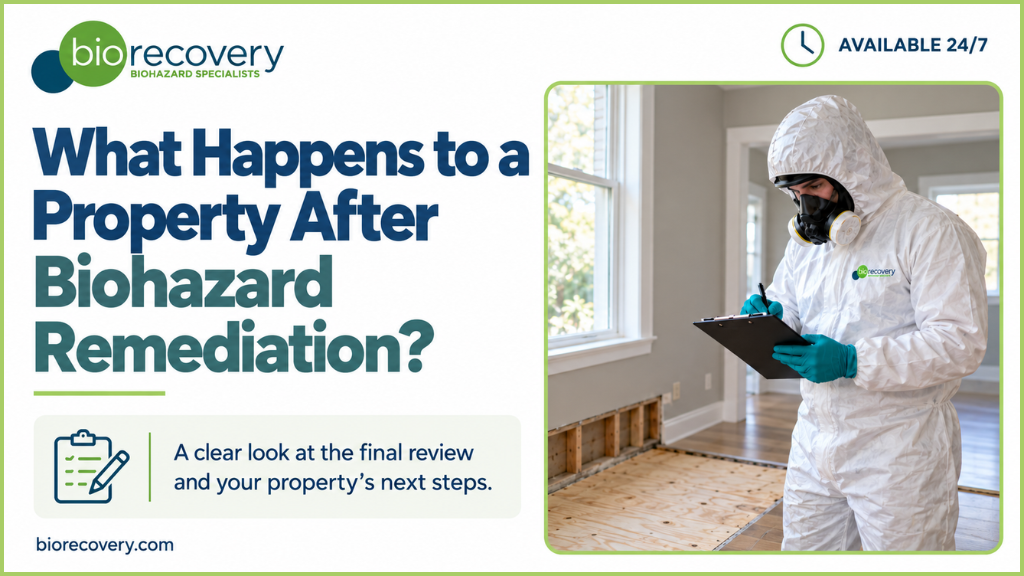
After biohazard remediation, your property either moves back toward normal use or enters a repair phase. We review the treated area with you, explain any remaining restrictions, and identify work outside the completed cleanup scope.
A room can still have missing flooring after we address the contamination beneath it. Understanding that difference helps you arrange repairs without assuming that an unfinished appearance means unfinished remediation.
Our professional biohazard cleanup includes a final inspection with you. That gives you a chance to ask about the property’s condition before signing the final inspection form.
What Will Your Property Look Like After Cleanup?
The property’s final appearance depends on whether we treated affected materials in place or removed them. Removal forms part of the biohazard cleanup process when contamination reaches material we cannot adequately clean.
Use the walkthrough to understand changes to the space and what each means for repairs.
| Property condition | What it can mean | What comes next |
|---|---|---|
| Original finishes remain | We treated suitable surfaces without removing them | Follow the instructions for using the treated area |
| Bare subfloor | We removed affected flooring or padding | Confirm the condition of the remaining layer before replacement |
| An opening in a wall | We removed affected drywall or accessed contamination behind it | Arrange the required wall repair after remediation |
| Missing baseboards | We needed access along a floor or wall edge | Include replacement trim in the repair scope |
| Furniture no longer occupies the room | We removed an item we could not restore | Confirm the item record before planning a replacement |
Does Every Mark Need More Treatment?
An existing scratch or worn finish can remain after cleanup without indicating biological contamination. Ask us about a mark you cannot identify rather than deciding what it means from appearance alone.
The important distinction is whether the mark represents remaining contamination or unrelated damage. We can explain our findings so you know whether the next step involves further assessment or a cosmetic repair.
How Do You Verify a Property Is Clean After Biohazard Remediation?
Verify the cleanup by comparing the completed work with the contamination we identified. Successful biohazard decontamination addresses affected materials and includes a final review of the defined work area. Appearance and odor alone cannot establish that result.
The review needs to account for the path of contamination. If fluid reached the layer below a carpet, cleaning the carpet’s visible surface would not address the entire finding.
Confirm the Treatment Reached the Affected Material
A suitable cleanup method must reach the contamination rather than cover it. Removing an absorbent material sometimes gives us access to a surface that needs treatment underneath.
Ask how we assessed the layers exposed during removal. This question matters when the original stain showed only part of the affected area.
Cleaning also prepares a surface for disinfection. Remaining biological residue can interfere with the product’s contact with the surface.
The EPA’s disinfectant directions explain that each product has approved uses and a required contact time. Contact time means how long the surface must remain visibly wet for the disinfectant to work as directed.
A product’s registration does not mean every application method suits every material. During the review, ask whether the treatment matched the surface involved.
Understand the Limits of Testing
Testing supports verification when the method fits the project. A result describes what the test measured at the sampled location.
For example, ATP testing helps assess organic material on a surface. Research on ATP monitoring explains that readings can include nonliving debris, so they do not directly measure microbial contamination.
When testing forms part of your cleanup, ask what we sampled and how the results informed the final review. A surface reading cannot describe an inaccessible layer underneath that surface.
You do not need to interpret technical results yourself. You need a clear explanation of how the findings support the decision about the treated area.
Resolve Any Remaining Limitation
An inaccessible area or an active leak can prevent completion of part of a proposed treatment. The handoff should explain that limitation and the action it requires.
Do not cover a known unresolved concern with new flooring or drywall. Clarify the next step with us before repair work closes the area.
What Should You Look for in a Post-Remediation Inspection Report?
Look for records tied to the actual work area rather than a general statement that the property is clean. Documentation varies by project, so ask which completion records your agreement includes.
These details help you understand the result and coordinate any later work.
| Record detail | What to look for | Why it matters |
|---|---|---|
| Project identification | Property address and work dates | Connects the records to your cleanup |
| Defined work area | Rooms or sections included in remediation | Establishes the scope of the completed work |
| Material decisions | Items treated in place and materials removed | Supports replacement planning |
| Treatment details | Methods used to address the identified contamination | Explains how we completed the work |
| Verification | Inspection findings and any test methods or sample locations | Documents the basis for the final review |
| Open items | Limitations, access restrictions, or work outside the agreement | Identifies what remains before normal use |
A completion record documents the cleanup it describes. It does not replace a separate assessment of structural damage or utility problems outside that work.
You can also ask which photographs support the records without reviewing images you prefer not to see. Written descriptions can help you discuss the scope with your insurer or anyone completing repairs.
When Can You Return to the Property?
Return after we confirm that you can enter the treated area and explain any remaining restrictions. Normal occupancy also depends on physical conditions that cleanup alone does not repair.
For example, removal of a subfloor section can leave an opening that needs repair before you use the room. Permission to attend a walkthrough does not automatically mean the space is ready for overnight occupancy.
Tell us how you plan to use the affected room. That lets us explain the handoff instructions in terms of your actual needs.
How Long Until the Space Is Ready?
The affected materials and extent of contamination determine how long cleanup takes. Some cleanups take several hours, while more extensive contamination can require multiple days.
Repairs then follow their own schedule when removal leaves the space unfinished. Ask for separate expectations for remediation completion and normal use, especially when replacement materials or drying affect the return date.
What Are the Next Steps After Professional Biohazard Cleanup?
Your next steps should follow the project’s remaining needs. Use the handoff instructions to organize repairs and your return.
- Resolve open tasks. Identify anything outside the completed agreement and who will coordinate it.
- Arrange required repairs. Give anyone repairing the property the information needed about removed materials and remaining openings.
- Return approved belongings. Move items into the room when the treatment and required repairs allow normal use.
- Keep a project file. Store the completion records with related invoices and repair documents.
How Do Cleanup Costs Differ From Repair Costs?
The cost of biohazard cleanup reflects the remediation work the property requires. Reconstruction or replacement finishes can involve separate expenses unless your agreement includes them.
Removal of contaminated carpet and installation of replacement carpet describe different tasks. Check the scope for both so you can account for the full project.
What Happens With the Insurance Claim?
The insurance claim can continue after the physical cleanup ends. Bio Recovery provides documentation to support the cleanup claim when insurance applies.
Your policy and the circumstances determine coverage, and your insurer decides which expenses qualify. Before ordering repair materials, ask whether the insurer needs to review the repair estimate.
What Happens to Belongings and Removed Waste?
At closeout, confirm which belongings we treated and which we removed. An item that still needs evaluation should remain separate from items ready to return to the room.
The record of removed belongings also supports replacement planning. Ask about an item you cannot account for before purchasing a replacement or submitting its value to your insurer.
We handle contaminated waste according to the requirements that apply to the project. The EPA explains that medical waste regulation primarily falls to state environmental and health departments, so requirements vary by location.
Waste classification depends on the material and applicable rules. Contaminated waste and ordinary repair debris do not automatically follow the same disposal route.
How Do You Care for Your Home After Biohazard Remediation?
Resume routine housekeeping once we confirm the treated area’s status and explain any surface-specific instructions. Ordinary cleaning maintains the space after remediation.
The CDC’s home cleaning guidance recommends regular cleaning of frequently touched surfaces with products that suit the material. Additional disinfection depends on household circumstances, including illness.
Ask us before applying another chemical to a surface when you are unsure about compatibility. You do not need to repeat the incident cleanup as part of everyday housekeeping.
What if You Notice a New Concern?
Report a returning odor or an unexplained stain in or near the treated area. Describe its location and when you first noticed the change.
An odor alone does not identify its source. A new leak or a condition outside the original cleanup area can also require review.
Avoid opening walls or lifting flooring to investigate possible contamination yourself. When you suspect renewed exposure, keep people away from the area and contact us for instructions.
What Should Property Managers Update After Cleanup?
Update your biohazard response plan with any lessons about property access or incident communication. This helps you respond to a future event without relying on someone’s memory of the last cleanup.
For example, identify who can authorize access when the usual manager is unavailable. Keep Bio Recovery’s contact information with the plan so the person responding knows whom to call.
Key Takeaways
After biohazard remediation, the final review should leave you with a clear understanding of the treated area and the next action.
- Missing finishes can reflect necessary material removal and create a separate repair phase.
- Verification should address the identified contamination and explain any testing limits.
- Completion records should describe the actual work scope and unresolved items.
- Follow the access instructions before returning the room to normal use.
Bio Recovery Biohazard Specialists provide cleanup nationwide and remain available 24/7. Contact Bio Recovery to discuss a post-cleanup concern or clarify the next step for your property.
Frequently Asked Questions
What happens after biohazard remediation?
We review the treated area and explain the completed work. Your property then moves toward normal use or required repairs, depending on its condition. The handoff should identify any remaining restrictions.
Can I verify the cleanup with a home test kit?
A home test cannot verify every part of a remediation project. Its result applies to what it measures at the sampled location, so it cannot establish the condition of hidden materials or the entire property.
Can I install new flooring immediately after cleanup?
Install replacement flooring after we confirm the remediation status of the underlying area and you resolve any condition that prevents installation. Do not cover an unresolved finding or an active moisture problem.
Can I stay in an unaffected part of the house?
That depends on the separation of the work area and your access route. Ask us about your specific rooms before staying, especially if reaching them requires entering a restricted area.
How often does biohazard remediation need renewal?
A completed cleanup of a one-time incident does not automatically need scheduled renewal. New contamination or an unresolved source calls for reassessment. Follow any project-specific instructions and contact Bio Recovery when the condition changes.