



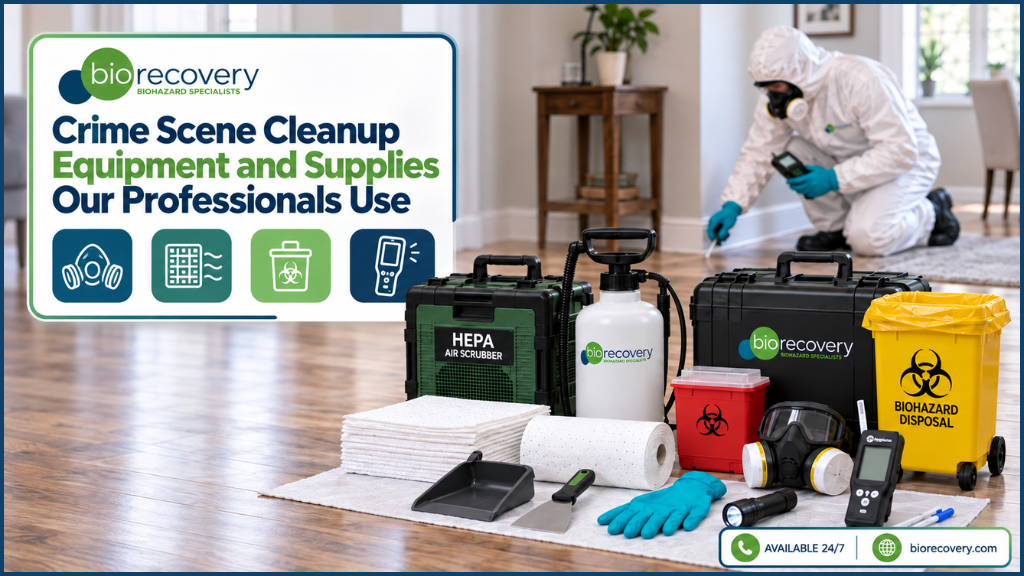
Blood, bodily fluids, and other contaminants can travel beneath flooring, soak into porous materials, or spread beyond the area you can see. Removing them requires more than a strong disinfectant or standard cleaning kit.
Our professionals select crime scene cleanup equipment based on the hazards, affected materials, and conditions found at each property. Through our crime scene cleaning services, we use protective gear, containment supplies, removal tools, cleaning products, waste containers, and verification equipment within one controlled remediation process.
The tools matter, but knowing how to select and use them matters more. Each item must fit the contamination, surface, and stage of the work.
What Equipment Is Needed for Crime Scene Cleanup?
Professional crime scene cleanup requires equipment for protection, containment, material removal, cleaning, disinfection, waste handling, odor control, and verification. The exact setup changes from one property to another.
| Equipment category | Common examples | Primary purpose |
|---|---|---|
| Protective equipment | Gloves, coveralls, eye protection, respirators | Reduce exposure to identified hazards |
| Containment supplies | Sheeting, barriers, signs, floor protection | Control access and limit cross-contamination |
| Removal tools | Absorbents, scrapers, scoops, cutting tools | Remove fluids and contaminated materials |
| Cleaning and verification equipment | Sprayers, HEPA equipment, inspection tools, ATP meters | Support decontamination and evaluate completed work |
A small amount of contamination on a hard surface does not require the same resources as blood that has reached carpet, padding, and subflooring. Before selecting equipment, our technicians assess:
- The type and amount of contamination
- Whether fluids reached porous or structural materials
- The presence of broken glass, needles, or other sharps
- Chemical residue or investigative materials
- Odor conditions and possible decomposition
- The size, layout, and ventilation of the property
- Applicable waste-handling requirements
Cleanup cannot begin until the investigating agency releases the property. Understanding what happens after a crime scene clarifies where evidence collection ends and property remediation begins.
Personal Protective Equipment for Crime Scene Cleaners
Personal protective equipment creates a barrier between our technicians and the hazards identified during the assessment. We select PPE based on the expected exposure rather than using the same setup at every scene.
| PPE category | Examples | How it protects our technicians |
|---|---|---|
| Body protection | Disposable protective coveralls | Limits contact between contamination and clothing or skin |
| Hand protection | Nitrile, cut-resistant, or puncture-resistant gloves | Protects against fluids, chemicals, and sharps |
| Face and eye protection | Safety goggles and face shields | Reduces exposure from splashes and debris |
| Foot protection | Protective footwear and disposable boot covers | Protects footwear and limits contamination transfer |
| Respiratory protection | Equipment selected for the identified hazard | Reduces inhalation exposure when respiratory protection is required |
Not every technician needs the same suit or respirator on every job. Splash risk, chemicals, airborne hazards, sharps, and the work being performed determine the required protection.
Our guide to PPE suits and masks explains how different forms of protective equipment shield the skin, eyes, face, and respiratory system.
What Happens to PPE After Cleanup?
Disposable gloves, coveralls, and boot covers are contained and discarded through the appropriate waste process. Reusable items such as goggles, face shields, and certain respirator components must be separated, cleaned, disinfected, dried, and inspected.
Technicians also follow a controlled PPE removal process. Careless removal can transfer contamination to skin, clothing, clean equipment, or areas outside the work zone.
Containment and Cross-Contamination Control Supplies
Containment supplies keep contaminants, used equipment, and removed materials from moving into unaffected areas. The layout follows the property’s design and the route technicians must use to enter, work, and remove waste.
Common crime scene cleanup supplies include:
- Plastic sheeting and temporary barriers
- Warning signs and barrier tape
- Disposable floor protection
- Sealable containers and liners
- Dedicated tools for controlled work zones
- Adhesive floor mats when conditions require them
Our team may designate separate areas for clean equipment, active remediation, and waste removal. This controlled movement helps prevent a contaminated tool or boot cover from carrying material beyond the original scene.
Crime Scene Cleaner Tools for Removing Contamination
Physical removal comes before surface disinfection. A disinfectant cannot reach the underlying surface evenly when blood, tissue, or other organic material remains in the way.
The CDC’s 2024 guidance requires blood and body-fluid contamination to be cleaned before the surface is disinfected. Crime scenes can involve more extensive contamination, but the distinction between removal, cleaning, and disinfection still applies.
| Tool category | Examples | When we use it |
|---|---|---|
| Fluid control | Absorbent pads, rolls, towels, solidifiers | To contain and collect liquid contamination |
| Surface removal | Scrapers, scoops, squeegees, brushes | To remove residue from compatible surfaces |
| Material removal | Utility knives, carpet tools, pry bars | To remove contaminated porous materials |
| Structural access | Oscillating tools and access equipment | To reach contamination beneath floors or inside walls |
| Sharps handling | Mechanical pickup tools and sharps containers | To limit direct contact with needles or broken glass |
A tool that works on a durable hard surface may damage wood, fabric, or a finished wall. We match each crime scene cleaner tool to the material and task.
Blood and bodily fluids can also move beyond a visible stain. When contamination reaches carpet padding, drywall, insulation, subflooring, or upholstered furniture, removing the affected material may provide the only reliable access to the full area.
What Do Crime Scene Cleaners Use to Clean Blood?
Our professionals use absorbents, mechanical removal tools, surface-appropriate cleaners, and EPA-registered disinfectants to address blood contamination. The process changes when blood has entered porous or structural materials.
The general sequence is:
- Control access to the affected area.
- Put on PPE selected for the hazards.
- Contain and remove liquid or dried biological material.
- Remove materials that cannot be adequately decontaminated.
- Clean remaining surfaces to remove residual organic matter.
- Apply a disinfectant approved for the surface and target pathogen.
- Maintain the required wet contact time.
- Inspect and document the completed work.
Cleaning blood is not the same as removing a visible stain. Contamination may remain in cracks, seams, padding, or nearby materials even after the surface looks clean.
Standard household tools can also spread contaminants. A mop, vacuum, or brush exposed to a crime scene should not return to ordinary household use without proper decontamination.
What Chemicals Do Crime Scene Cleaners Use?
Our professionals choose biohazard cleaning chemicals according to the contaminant, surface, and intended result. No single cleaner or disinfectant works for every crime scene.
| Product category | Primary function | Important limitation |
|---|---|---|
| Detergents | Loosen soil and residue | Do not automatically disinfect |
| Enzyme cleaners | Break down protein-based organic material | Require a separate disinfectant unless registered for both uses |
| EPA-registered disinfectants | Address pathogens listed on the label | Must match the pathogen, surface, and contact time |
| Odor-treatment products | Address odors after remediation | Cannot replace source removal |
Cleaning Agents and Enzyme Products
Cleaning agents remove soil that can interfere with disinfection. Enzyme cleaners help break down proteins found in blood and other biological material.
An enzyme product is not automatically a disinfectant. We use every crime scene cleaning product only for the purpose stated on its label.
EPA-Registered Disinfectants
A disinfectant must match the target pathogen and surface being treated. Its label also states the dilution, application method, safety precautions, and time the surface must remain wet.
The EPA advises users to verify the registration number, pathogen claim, surface type, directions, and contact time before using a product against bloodborne pathogens. Its current List S contains products registered for use against HIV, hepatitis B, hepatitis C, or a combination of those viruses.
A description such as “hospital-grade” does not provide enough information by itself. The registration and label determine whether a disinfectant fits its intended use.
Chemical Compatibility and Safe Use
A product can control a listed pathogen and still damage the material beneath it. We consider surface compatibility along with the required pathogen claim.
Our technicians do not mix products unless the manufacturer specifically directs it. Correct dilution, complete coverage, and full contact time matter more than using an unnecessarily strong concentration.
Specialized Biohazard Cleaning Equipment
Certain machines help manage particles, apply products, or address remaining odors. They support remediation but cannot replace direct access to contamination and physical source removal.
| Equipment | Intended use | What it cannot do |
|---|---|---|
| HEPA air scrubbers | Capture fine airborne particles | Remove contamination absorbed into building materials |
| HEPA-filtered vacuums | Collect appropriate dry particles | Serve as a universal tool for liquid biological material |
| Pump sprayers | Apply compatible products evenly | Replace physical cleaning |
| Fogging equipment | Distribute products approved for that application | Reach blood sealed beneath floors or walls |
| Odor-control systems | Address remaining odors after source removal | Correct biological material left inside the property |
Odor Treatment and Ozone Equipment
Odor treatment starts with locating and removing the source. Air scrubbers, hydroxyl generators, and other odor-control systems cannot correct biological material that remains beneath a surface.
Ozone equipment requires strict controls. The EPA explains that ozone is a lung irritant and that concentrations used to reduce odors in unoccupied spaces can exceed levels considered safe for people.
We consider ventilation, occupancy, affected materials, and manufacturer instructions before selecting any odor-treatment equipment.
Biohazard Waste Containers and Disposal Supplies
Waste containers must match the material being removed. Soft contaminated items, sharps, and affected building materials require different containment methods.
Our biohazard cleanup supplies may include:
- Marked biohazard bags
- Puncture-resistant sharps containers
- Leak-resistant rigid containers
- Sealed transport containers
- Labels and warning markings
- Wrapping materials for building components
- Waste-tracking records
Needles, broken glass, and other sharps require rigid containers that resist punctures. Placing them in a flexible bag could expose technicians, transport workers, or waste personnel to injury.
Waste requirements differ by material and jurisdiction. Our nationwide teams follow the state and local requirements that apply where the cleanup takes place.
Inspection, Documentation, and Verification Equipment
Inspection and verification equipment helps us identify affected areas, document completed work, and evaluate the remediation results. No single device can verify an entire property by itself.
Our tools may include:
- Portable work lights and flashlights
- Cameras for authorized documentation
- Moisture meters when fluid migration is a concern
- Inspection mirrors and measurement tools
- Site diagrams, work logs, and checklists
- ATP testing equipment when appropriate
Lighting helps technicians examine dark, textured, reflective, or damaged materials where residue may be difficult to see. Documentation also supports communication with property owners, insurance adjusters, and other authorized parties.
What ATP Testing Can and Cannot Confirm
ATP testing detects adenosine triphosphate, which is present in biological and organic material. A technician swabs a selected surface and places the sample into a meter that returns a numerical reading.
The CDC notes that ATP testing has limited specificity, lacks one universal threshold for declaring a surface safe, and can be affected by cleaning products or surface materials. It does not identify a particular pathogen or prove that every harmful organism is absent.
We may use ATP results with visual inspection, removal records, cleaning documentation, and the conditions found at the scene. We do not treat one reading as a guarantee that the entire property is free from contamination.
Why Professional Equipment Is Only Part of the Process
Crime scene cleanup equipment works only when trained professionals select it for the correct hazard and use it within a controlled process. Owning a respirator, disinfectant, or testing device does not provide the knowledge needed to identify hidden contamination.
The party who must arrange remediation depends on where the incident occurred and who controls the property. Our explanation of who is responsible for cleaning a crime scene covers how that responsibility changes across homes, rental properties, businesses, and public locations.
Professional cleanup keeps you from having to manage biohazards, sharps, chemicals, waste, and emotionally difficult conditions yourself. Our team brings the equipment and experience required to complete the work responsibly.
Frequently Asked Questions
What equipment is necessary for professional biohazard cleanup?
Professional biohazard cleanup can require PPE, containment supplies, removal tools, cleaning products, disinfectants, waste containers, specialized machines, and verification tools. The scene assessment determines which equipment is necessary.
What is used to clean a crime scene?
Our professionals use equipment selected for the contamination and affected materials. This may include absorbents, enzyme cleaners, EPA-registered disinfectants, structural-removal tools, waste containers, and inspection equipment.
What chemicals do crime scene cleaners use?
Crime scene cleaning products may include detergents, enzyme cleaners, and EPA-registered disinfectants containing ingredients such as hydrogen peroxide, quaternary ammonium compounds, or sodium hypochlorite. Selection depends on the label claim, surface, contact time, and contamination.
Do crime scene cleaners always wear hazmat suits?
No. Our technicians select PPE according to the hazards and work being performed. Protection may include coveralls, gloves, eye protection, footwear, and respiratory equipment.
Crime Scene Cleanup Equipment Supports a Controlled Process
Professional crime scene cleanup equipment serves a specific purpose at each stage of remediation. Our technicians assess the property, control the work area, remove contaminated materials, clean and disinfect compatible surfaces, contain waste, and evaluate the completed work.
No tool or chemical completes that process by itself. Safe remediation depends on matching the equipment to the hazard and using it with the right training, work practices, and controls.
If blood, bodily fluids, or other biohazards remain after authorities release a property, contact us. Bio Recovery Biohazard Specialists will assess the conditions, explain the next steps, and provide professional assistance nationwide.