


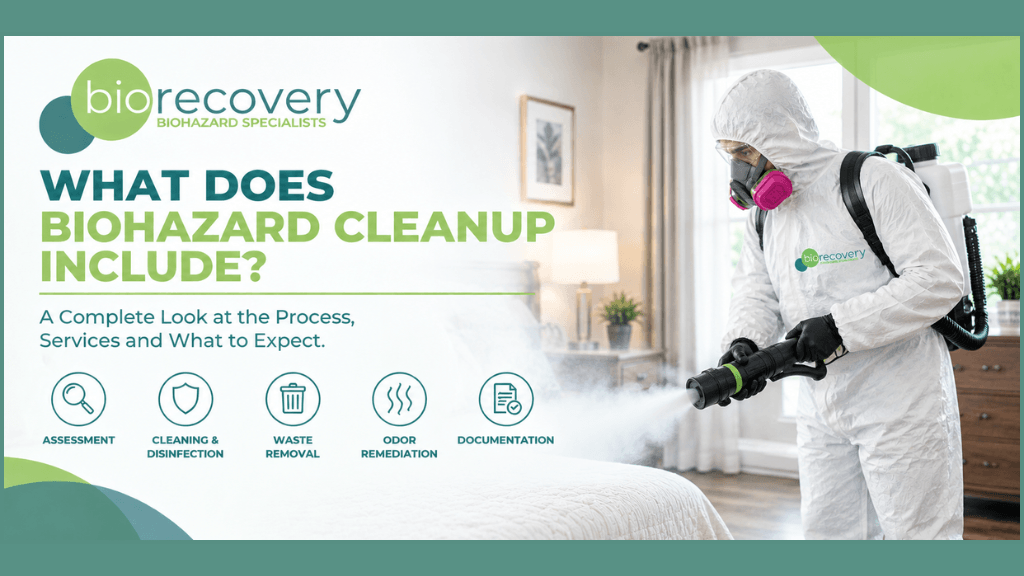
Professional biohazard cleanup includes assessing the affected area, controlling contamination, removing biological materials, cleaning and disinfecting affected surfaces, handling contaminated waste appropriately, and addressing odors or damaged materials when necessary. The exact scope depends on the type of incident, the materials affected, and the extent of contamination.
At Bio Recovery, we provide specialized biohazard remediation for situations involving blood, bodily fluids, unattended deaths, crime scenes, trauma, and other biological hazards. Our process is designed around the conditions of each property rather than a one-size-fits-all cleaning checklist.
Need professional biohazard cleanup? Call Bio Recovery at 1-888-752-5001 for 24/7 assistance.
What Is Included in Professional Biohazard Cleanup?
Professional biohazard cleanup goes beyond making a surface look clean. Depending on the incident, the work may include:
- Assessing visible and potentially hidden contamination.
- Establishing appropriate work-area controls and containment.
- Using personal protective equipment (PPE).
- Removing biological contamination from affected surfaces.
- Cleaning and disinfecting materials that can be appropriately remediated.
- Removing materials that cannot be adequately cleaned.
- Handling and disposing of contaminated waste through appropriate procedures.
- Addressing persistent biological odors when necessary.
- Documenting the remediation work.
- Identifying additional repairs or restoration that may be required.
Not every project requires every step. A contained blood spill may need a different scope from an unattended death involving decomposition and affected flooring.
For an overview of the services available, visit our professional biohazard cleanup service page.
1. Initial Assessment of the Affected Area
The first stage is determining what happened, where contamination is located, and what work may be necessary.
During an assessment, a remediation team may evaluate:
- The type of biological contamination.
- The size and location of the affected area.
- Visible contamination and potential spread beyond visible surfaces.
- Porous materials such as carpet, upholstery, and unfinished wood.
- Nonporous surfaces that may be cleaned and disinfected.
- Whether flooring, subflooring, drywall, furnishings, or other materials may be affected.
- Odors and other conditions that may require additional remediation.
- Access, containment, and waste-handling requirements.
The assessment helps establish a suitable scope of work. It also helps identify situations in which additional inspection, material removal, or restoration may be necessary.
2. Personal Protective Equipment and Containment
Biohazard remediation may expose workers to potentially infectious materials and other hazards. Appropriate protective equipment and work-area controls help reduce exposure risks and limit the spread of contamination.
Depending on the situation, this stage may include:
- Selecting PPE appropriate to the hazards involved.
- Restricting access to the affected area.
- Establishing containment where necessary.
- Separating affected and unaffected areas.
- Using appropriate procedures for equipment and material handling.
- Taking precautions to prevent cross-contamination.
The controls required depend on the incident and site conditions. Not every cleanup requires the same containment setup or equipment.
For relevant workplace requirements, consult OSHA’s Bloodborne Pathogens Standard.
3. Removal of Blood, Bodily Fluids, and Biological Materials
The remediation team removes biological contamination from affected areas using procedures appropriate to the materials and conditions.
This may involve blood, bodily fluids, decomposition-related contamination, or other biological materials associated with a traumatic incident.
The work may include:
- Removing visible biological materials.
- Cleaning affected surfaces.
- Addressing contamination around seams, joints, and other difficult-to-clean areas.
- Assessing whether contamination has reached porous or concealed materials.
- Determining whether affected contents or building materials require removal.
Visible cleaning is only one part of remediation. The team must also consider whether the affected materials can be adequately cleaned and disinfected.
Learn more about our blood and bodily-fluid cleanup services.
4. Cleaning and Disinfection
After biological materials have been addressed, appropriate cleaning and disinfection procedures are used for the affected surfaces and materials.
These are related but different tasks:
- Cleaning removes contamination and unwanted material from a surface.
- Disinfection uses an appropriate product and procedure to address microorganisms on a surface or material.
The correct approach depends on the surface, the contamination, and the disinfectant’s intended use and label instructions.
Professional remediation may involve multiple cleaning and disinfection steps rather than relying on a single product or treatment.
Not every porous material can be restored through surface cleaning. When contamination has penetrated a material, the remediation team may determine that removal is necessary.
5. Removal of Contaminated Materials
Some materials cannot be adequately remediated in place. When this occurs, removal may be part of the cleanup scope.
Potentially affected materials include:
- Carpet and carpet padding.
- Upholstered furniture.
- Mattresses and other soft furnishings.
- Flooring and subflooring.
- Portions of drywall or insulation.
- Other porous building materials or contents.
Whether a material needs to be removed depends on the type and extent of contamination, the material itself, and whether appropriate remediation is feasible.
Material removal may increase the project’s cost and timeline. Replacing removed flooring, drywall, or other building components may require a separate repair or restoration contractor.
Bio Recovery can discuss the remediation work required for the specific property and identify additional work that may be needed.
6. Biohazard Waste Handling and Disposal
Contaminated materials cannot simply be treated as ordinary household rubbish without considering the applicable requirements.
Depending on the incident and waste type, professional remediation may include appropriate containment, packaging, handling, transportation, and disposal of contaminated materials.
The exact requirements depend on the material and the applicable federal, state, and local rules.
Waste handling is an important part of the overall process because removing contamination from a property also requires managing the resulting waste appropriately.
For more information about evaluating a provider’s procedures, read our guide on how to choose a biohazard cleanup company.
7. Odor Remediation When Necessary
Some incidents, particularly unattended deaths involving decomposition, can cause persistent odors.
Odor remediation may be needed when biological contamination has affected porous materials, furnishings, flooring, or other parts of a property.
Depending on the conditions, the work may involve:
- Identifying and addressing the underlying source of the odor.
- Removing contaminated materials when necessary.
- Cleaning affected surfaces.
- Using suitable odor-remediation methods.
- Assessing whether additional material removal or restoration is needed.
Masking an odor is not the same as addressing its source. The remediation approach should account for the underlying contamination rather than relying solely on fragrances or air treatment.
Not every biohazard cleanup requires specialized odor remediation.
8. Documentation and Final Review
Documentation can help property owners, families, businesses, and insurers understand what work was performed.
Depending on the project, relevant records may include:
- The remediation scope.
- The affected areas and materials.
- Photographs or other records, where appropriate.
- Work performed and materials removed.
- Invoices and related project documents.
- Information relevant to an insurance claim.
At the end of the project, the work should be reviewed against the agreed scope. Any remaining repairs or other follow-up requirements should be identified.
Documentation does not automatically guarantee insurance coverage or certify that a property meets every possible regulatory requirement. Those determinations depend on the circumstances and the applicable standards.
What Is Included in Different Types of Biohazard Cleanup?
The exact service depends on the incident. The following table illustrates how the scope may differ.
| Type of cleanup | Potentially included work |
| Blood cleanup | Removal of blood, surface cleaning, disinfection, and handling of contaminated materials |
| Crime scene cleanup | Assessment, contamination removal, cleaning, disinfection, and material removal where necessary |
| Unattended death cleanup | Biological remediation, assessment of affected materials, waste handling, and odor remediation when needed |
| Suicide cleanup | Remediation of blood and bodily-fluid contamination, cleaning, disinfection, and affected-material removal when necessary |
| Infectious disease-related cleaning | Assessment and cleaning or disinfection appropriate to the organism, exposure, surfaces, and circumstances |
| Hoarding-related biohazard cleanup | Assessment of biological contamination, affected materials, waste, and unsanitary conditions |
| Commercial biohazard cleanup | Remediation coordinated around affected workspaces, shared areas, access controls, and business operations |
These are general descriptions, not guarantees that every listed task will be required or included in every estimate. The actual scope should be established for the incident.
What Is Usually Not Included in Basic Biohazard Cleanup?
One of the most important questions to ask is what the quoted scope does not include.
Depending on the company, property, and incident, the following may require separate authorization, specialist services, or a different contractor:
- Rebuilding walls or ceilings after contaminated materials are removed.
- Installing new flooring, carpet, drywall, or insulation.
- Replacing damaged furniture or personal belongings.
- General remodeling and cosmetic repairs.
- Structural repairs unrelated to the agreed remediation scope.
- Plumbing, electrical, or other specialist building work.
- Long-term property restoration after cleanup.
- Additional areas of contamination discovered outside the original scope.
Some companies may coordinate certain additional services, while others may only perform remediation. Ask for a written scope that distinguishes included work from possible additional expenses.
Is Biohazard Cleanup the Same as Regular Cleaning?
No. Routine cleaning generally focuses on dirt, dust, and ordinary surface grime. Biohazard remediation addresses biological contamination that may pose exposure risks and require specialized procedures.
Professional biohazard cleanup may involve:
- Hazard assessment and work-area controls.
- PPE appropriate to the conditions.
- Specialized cleaning and disinfection.
- Removal of materials that cannot be adequately remediated.
- Appropriate waste handling.
- Odor remediation when necessary.
- Documentation of the work performed.
Ordinary cleaning products and routine housekeeping procedures should not be assumed to be sufficient for every biological contamination incident.
If you are unsure whether an incident requires professional help, describe the situation to a qualified remediation provider rather than entering or disturbing a potentially hazardous area.
Can You Handle Biohazard Cleanup Yourself?
Small, routine cleaning tasks and significant biohazard incidents are not equivalent. When an incident involves substantial blood or bodily fluids, decomposition, unknown biological materials, sharps, or contamination that has penetrated building materials, professional assessment is strongly recommended.
Do not enter an active crime scene or disturb evidence. Wait until the appropriate authorities release the area before arranging remediation.
If there is an immediate threat, an injury, or another emergency, contact emergency services first. Keep other people away from the affected area while following appropriate safety instructions.
How Long Does Biohazard Cleanup Take?
The time required depends on the type of incident, the extent of contamination, and the materials affected.
A contained cleanup may take several hours, while a complex unattended death, advanced decomposition, or project involving structural material removal may require multiple days or longer.
Factors that can affect the timeline include:
- The size of the affected area.
- The amount and type of contamination.
- Whether contamination has reached porous materials.
- The need for containment.
- Material removal and waste handling.
- Odor-remediation requirements.
- Access restrictions and site conditions.
- Follow-up repairs or restoration.
Read our detailed guide: How Long Does Biohazard Cleanup Take?.
How Much Does Biohazard Cleanup Cost?
There is no single price for every biohazard cleanup project. The total depends on the incident and the work required.
Factors may include the size of the affected area, type of contamination, materials affected, labor, protective equipment, containment, waste handling, odor remediation, and removal of building materials.
When reviewing an estimate, ask which tasks are included, what might cost extra, and whether repairs or reconstruction are outside the scope.
For more detail, see our biohazard cleanup cost guide.
Does Insurance Cover Biohazard Cleanup?
Insurance may cover some biohazard remediation costs, but coverage depends on the policy, the cause of the incident, exclusions, deductibles, and claim requirements.
Contact your insurance company to confirm coverage and ask what documentation it needs. Where circumstances allow, clarify whether approval is required before particular work begins.
Bio Recovery can discuss available remediation documentation and payment options, but the insurer determines coverage under the applicable policy.
Visit Bio Recovery’s pricing and payments page for additional information.
How to Choose a Biohazard Cleanup Company
When comparing remediation providers, look beyond the quoted price. Ask about technician training, relevant credentials, insurance, safety procedures, containment, waste handling, experience with your type of incident, and the documentation you will receive.
A professional provider should be able to explain:
- What the assessment covers.
- How the affected area will be controlled.
- What cleaning and disinfection procedures are proposed.
- Which materials may require removal.
- How contaminated waste will be handled.
- What the estimate includes and excludes.
- Whether additional restoration may be necessary.
Read our guide on how to choose a biohazard cleanup company before comparing providers.
What Does Bio Recovery Include in Its Biohazard Cleanup Services?
At Bio Recovery, the remediation scope depends on the incident, the affected materials, and the conditions at the property.
Our service information describes a process that can include assessment, work-area controls, PPE, cleaning and disinfection, removal of materials that cannot be appropriately remediated, waste handling, and odor remediation when needed.
We provide specialized biohazard cleanup for residential and commercial properties, including incidents involving blood, bodily fluids, crime scenes, unattended deaths, and other biological contamination.
Before work begins, ask our team to explain the proposed scope, what is included, what may require additional work, and what documentation will be available.
Call Bio Recovery at 1-888-752-5001 for 24/7 assistance.
Frequently Asked Questions
What does biohazard cleanup include?
It can include assessment, appropriate containment, PPE, biological material removal, cleaning and disinfection, contaminated-material removal, waste handling, odor remediation when necessary, and documentation. The exact scope depends on the incident.
Does biohazard cleanup include disinfection?
Professional biohazard remediation generally includes appropriate cleaning and disinfection of affected surfaces and materials. The specific products and procedures depend on the contamination and the materials involved.
Does biohazard cleanup include removing carpet and flooring?
It may. Carpet, padding, flooring, subflooring, or other materials may require removal if they cannot be adequately remediated. Removal and replacement depend on the assessment and agreed scope.
Does biohazard cleanup include odor removal?
Odor remediation may be included when necessary, especially in incidents involving decomposition. The appropriate treatment depends on the source of the odor and the materials affected.
Does biohazard cleanup include waste disposal?
Appropriate handling and disposal of contaminated waste are important parts of professional remediation. Requirements depend on the waste type and applicable regulations.
Does biohazard cleanup include repairs and reconstruction?
Not necessarily. Remediation and reconstruction are different scopes of work. Ask whether replacing flooring, drywall, insulation, furniture, or other materials is included or requires a separate contractor.
How long does biohazard cleanup take?
Some contained projects may take several hours, while complex incidents may require multiple days or longer. The timeline depends on contamination, materials, access, and any additional remediation or repair work.
How much does biohazard cleanup cost?
Costs depend on the incident, size of the affected area, materials involved, labor, containment, disposal, and additional remediation.
Can I clean up a biohazard myself?
For significant biological contamination, professional assessment is strongly recommended. Do not disturb active crime scenes, and follow emergency guidance if there is an immediate threat or injury.
How do I arrange professional biohazard cleanup?
Contact Bio Recovery at 1-888-752-5001. Explain what happened, the affected location, and any immediate concerns so the team can discuss the appropriate next steps.
Get Help With Biohazard Cleanup
Understanding what biohazard cleanup includes can help you make informed decisions during a difficult situation. The right scope depends on the contamination, the materials affected, and the work required to remediate the property.
Bio Recovery is available 24/7 to discuss your situation, explain the remediation process, and help you understand the next steps.
Call 1-888-752-5001 to speak with Bio Recovery.