



A closed door may keep someone out of a room, but it cannot control what leaves on shoes, gloves, equipment, or waste containers. Biological material can move beyond the original scene when people enter the area or carry affected items through the property.
Biohazard containment zones create controlled boundaries around the affected area. During professional biohazard cleanup, we use these boundaries to limit access and control how technicians and materials move through your property.
Each setup reflects the incident and the conditions we find. A blood spill on a hard surface does not require the same containment plan as an unattended death involving flooring or several connected rooms.
What Are Biohazard Containment Zones?
Biohazard containment zones are designated areas that separate active cleanup from unaffected parts of a property. They establish where specific access, protective equipment, material handling, and cleanup procedures apply.
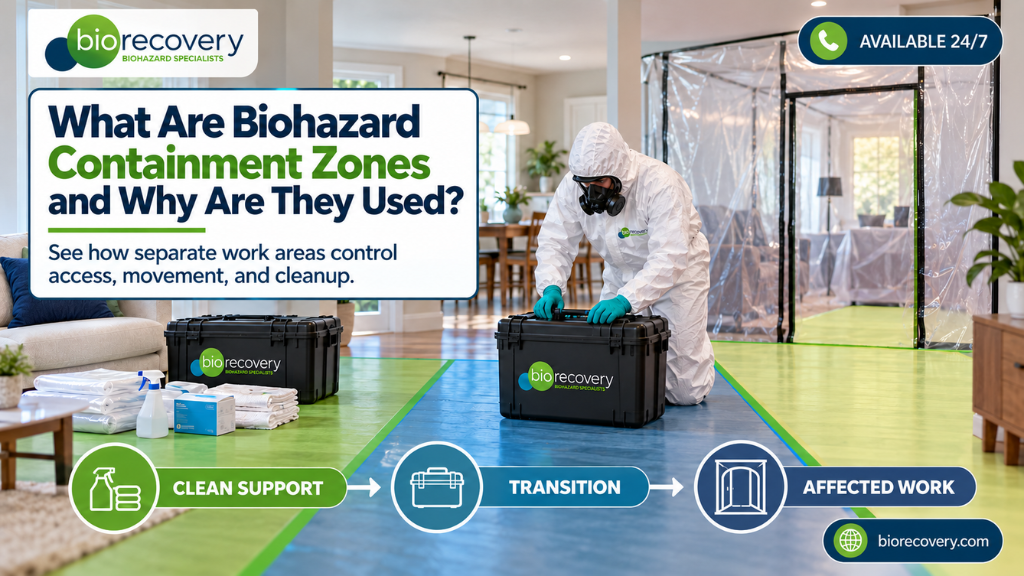
The terminology can change between projects. However, a containment plan generally separates the affected work area from a controlled transition point and a clean support space.
| Zone | Purpose | Activities and access |
|---|---|---|
| Affected work zone | Contains actual or suspected contamination | Authorized technicians assess surfaces, remove affected materials, clean, and disinfect |
| Transition zone | Controls movement across the work boundary | Technicians enter and exit, remove protective equipment, check tools, and transfer contained materials |
| Clean support zone | Protects supplies that have not entered the work area | Technicians stage unused equipment, complete documentation, and coordinate the project |
The CDC and National Institute for Occupational Safety and Health identify similar hot, warm, and cold areas in their guidance on protective equipment and contamination control. That guidance addresses highly infectious agents, so a property cleanup may use different terms or a simpler physical layout.
A zone establishes where precautions apply. It does not prove that every object inside the boundary contains biological material.
Why Are Biohazard Containment Zones Used?
Containment limits opportunities for biological material to leave the work area. It also keeps occupants away from possible exposure while giving our technicians a defined route for entering, leaving, and removing materials.
Shoes, gloves, equipment, belongings, and leaking containers can carry material to previously unaffected surfaces. Because these transfer points are not always obvious, each containment plan is designed to prevent biohazard cross contamination throughout the project.
The zones also preserve a clean location for unused supplies. A new pair of gloves or unopened cleaning material should not sit beside equipment that has already entered the affected area.
Containment does not remove the hazard by itself. It creates the controlled conditions needed to assess and address the contamination without extending the cleanup scope.
How Do We Determine the Containment Boundaries?
We determine containment boundaries through a site assessment rather than using one standard distance around a visible stain. The boundary must account for the original incident and any way the material may have moved afterward.
Several conditions shape the final layout:
- The source and visible extent of the contamination. We identify where the incident occurred and which nearby surfaces show biological material.
- The materials beneath the surface. Carpet padding, unfinished wood, subflooring, furniture seams, and wall materials may hold fluid beyond what remains visible.
- Movement after the incident. We ask who entered the area, where they walked, what they touched, and whether anyone moved affected belongings.
- The building layout. Doors, stairs, shared hallways, elevators, and occupied rooms influence where we can create a controlled entrance and removal route.
- The work we expect to perform. Removing flooring or another building material may require more protected space than cleaning an isolated hard surface.
- The people who remain at the property. We plan the zones so occupants do not have to cross the work area or the material removal route.
- Conditions discovered during cleanup. We can expand the boundary when removing a surface reveals additional affected material underneath or nearby.
The CDC’s 2024 environmental cleaning procedures recommend a preliminary assessment before cleaning and an organized progression from cleaner areas toward more contaminated areas. The guidance addresses healthcare environments, but these movement principles show why site layout and work order matter.
An expanded boundary does not mean the cleanup caused contamination to spread. It means the work revealed part of the original impact that was not visible during the first assessment.
How Do Biohazard Containment Zones Fit Into Cleanup?
Containment connects the initial assessment to the physical work. It remains in place during the parts of the biohazard cleanup process that could expose people or move affected material.
The work generally follows this sequence:
- Assess the scene. We identify the source, affected surfaces, concealed areas, and possible transfer routes.
- Establish the zones. We mark the work boundary, choose an entrance and exit, and select a separate space for clean supplies.
- Prepare the route. We protect surfaces as needed and determine how technicians and contained materials will move through the property.
- Remove affected material. We address biological material and remove porous items or building materials that cannot be cleaned within the agreed scope.
- Clean and disinfect suitable surfaces. We remove biological soil before applying an appropriate disinfectant according to its label.
- Package removed materials. We contain disposable materials before moving them through the transition point and along the planned route.
- Review the work. We compare the completed work with the agreed scope before removing the containment boundary.
The EPA’s List S for bloodborne pathogens identifies registered products for HIV, hepatitis B, and hepatitis C. The EPA states that directions and contact times can differ by pathogen, which makes the product label part of the disinfection process.
Why Do Porous Materials Affect the Containment Plan?
Porous materials can hold biological fluid beneath an exposed surface. Carpet, padding, unfinished wood, insulation, and upholstered furnishings may contain affected areas that ordinary surface treatment cannot reach.
These materials can also change the physical scope of the project. Removing carpet may expose an affected subfloor, while opening a wall or cabinet area may reveal a path that extends beyond the original boundary.
We evaluate each material before deciding whether it can remain. Its location inside a work zone does not automatically mean it must be discarded.
Does Every Cleanup Use the Same Zone Layout?
No. Biohazard containment zones must fit the affected materials, property layout, and work required.
The examples below show how different conditions can change the boundary:
| Situation | Main concern | Possible containment layout |
|---|---|---|
| Limited blood spill on a hard surface | Immediate spill and nearby contact points | Small restricted work area with a controlled exit |
| Blood beneath carpet or flooring | Surface material and affected layers underneath | Room or section containing the materials being assessed |
| Unattended death | Contents, structural materials, and removal route | Controlled room with a separate transition point |
| Multiple affected rooms | Movement between rooms and shared surfaces | Connected work area with one managed entrance |
| Shared commercial property | Common corridors, occupants, and business access | Isolated work area with a protected removal route |
These examples do not assign a required setup to every incident. The actual containment plan follows the evidence found at the property.
When Are Physical Barriers or Air Controls Needed?
Physical barriers create separation when existing walls and doors cannot provide an effective boundary. Depending on the project, we may use temporary sheeting, protective coverings, or a designated access point.
Air controls require their own assessment. We consider whether the planned work could disturb affected materials or create dust that may leave the controlled area.
Negative air equipment is not a standard requirement for every cleanup. We select air control methods according to the site conditions and work being performed.
How Do Regulations Affect Containment?
Containment forms one part of a larger safety and compliance plan. Worker protection, protective equipment, material classification, transport, and disposal requirements can affect how we set up and manage the work area.
Applicable biohazard cleanup regulations depend on the material, work activities, and jurisdiction. A barrier does not replace the handling and disposal procedures required for the materials removed from the property.
Are Containment Zones the Same as Biohazard Levels?
No. Containment zones organize cleanup at a specific property, while biosafety levels establish laboratory practices and facility controls for handling biological agents.
How Many Biohazard Levels Are There?
The CDC defines four biosafety levels, known as BSL-1 through BSL-4. These levels account for the biological agent, laboratory activity, protective practices, safety equipment, and facility design.
A 2025 CDC publication explains how risk groups help determine the appropriate biosafety level for laboratory work. These laboratory classifications do not determine how many rooms a cleanup crew should restrict at a home or business.
The four biohazard levels apply primarily to laboratories that handle biological agents under controlled conditions. A severe property incident does not turn a home or business into a BSL-3 or BSL-4 facility.
When Can a Containment Zone Be Removed?
We remove a containment zone after completing the work assigned to that area and reviewing the result. A certain amount of time or the disappearance of an odor does not make the space ready for release.
Before removing the boundary, we confirm that:
- The agreed material removal is complete
- Suitable surfaces received the planned cleaning and disinfection
- Disposable materials and protective equipment have been contained
- Reusable tools received the required cleaning or handling
- Temporary coverings can be removed without spreading material
- Separate repair or restoration needs have been documented
One part of a property may be released while another remains restricted. We make that decision according to the completed scope in each area.
What Should You Do While Containment Is in Place?
Stay outside the restricted area unless we tell you that entry is safe. Moving belongings or opening a barrier can create new contact with affected materials.
You can take the following steps without entering or handling the scene:
- Keep people and pets away from the affected area.
- Close a door if you can reach it without crossing the space.
- Leave furniture and personal belongings where they are.
- Tell us who entered and where they walked.
- Identify anything that someone moved after the incident.
- Seek medical advice after possible exposure to another person’s blood or bodily fluids.
Keeping the area undisturbed is part of our 8 step biohazard response plan that begins with recognizing the hazard and limiting access.
Key Takeaways About Biohazard Containment Zones
Biohazard containment zones separate active cleanup from unaffected parts of a property. They help us control access and movement while we remove materials, clean suitable surfaces, and prepare the area for its next use.
The main points are:
- Boundaries follow the incident and possible transfer routes.
- Hidden contamination can extend beneath visible surfaces.
- The containment layout can change when new conditions appear.
- Cleanup zones and laboratory biosafety levels serve different purposes.
Bio Recovery Biohazard Specialists provide nationwide support for affected homes, businesses, and vehicles. Contact Bio Recovery when you need help securing an area and determining what should happen next.
Frequently Asked Questions
What is a biohazard containment unit?
A biohazard containment unit can describe a specialized room, enclosure, clinical unit, or temporary controlled work area. It does not identify one standard piece of equipment used for property cleanup.
Can I remain in the building during biohazard cleanup?
You may be able to remain in a part of the building that stays separate from the work and removal routes. We assess the property and explain which areas must remain restricted.
Can belongings leave a containment zone?
Do not remove belongings yourself. We first assess whether an item contacted biological material and determine how it should be handled before it crosses the work boundary.
How long does a containment zone stay in place?
The zone remains until we complete and review the work assigned to that area. The timeline depends on the materials involved, the cleanup scope, and any additional affected areas found during the project.