


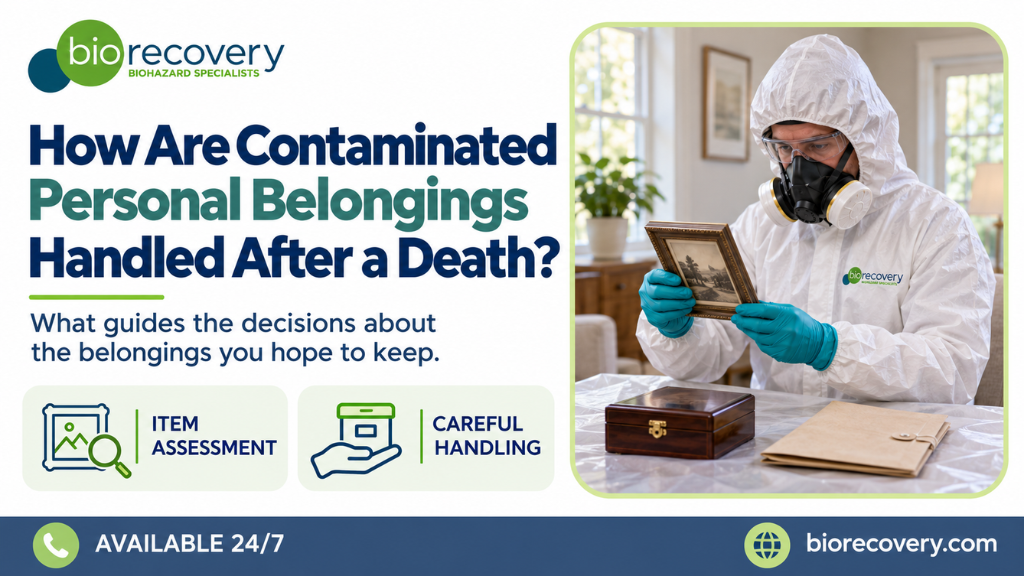
Contaminated personal belongings need an assessment before anyone decides what to keep or discard. At Bio Recovery, we identify affected items and explain whether treatment can address the contamination or removal is necessary.
A death inside a home does not make every possession a biohazard. Our professional cleanup after death includes evaluating affected belongings alongside the surrounding property, with attention to the items you hope to preserve.
What should you do before cleanup begins?
Limit access to the affected area before biohazard cleanup and contact us from a safe location. You can help with planning without handling contaminated possessions.
If you have just discovered someone who may have died, call 911 and follow the dispatcher’s instructions. Authorities must release any restricted scene before our property assessment after a death can begin.
What information helps us plan the assessment?
Use information you already have rather than entering the affected space to confirm details. Useful information includes:
- Which rooms the incident affected.
- Whether authorities still restrict access.
- Whether anyone attempted cleaning before contacting us.
- The person coordinating property access.
- Shared hallways or other access concerns.
You do not need to gather belongings into piles or take insurance photographs yourself. Leave affected furniture and clothing where they are, and avoid applying cleaning products while waiting.
How do we assess contaminated personal belongings?
We assess contaminated personal belongings by tracing exposure and checking whether a suitable treatment can reach the affected material. An item’s location starts the inspection, but it does not determine the outcome.
Did contamination actually reach the item?
We look for direct contact with blood or bodily fluids, along with possible transfer from other surfaces. Someone carrying an affected object through another room can create a second area to assess.
A dresser beside the incident may have contamination beneath it even when its top looks untouched. In contrast, an object farther away may have no identified exposure.
Does odor mean a belonging is contaminated?
Odor alone does not establish biological contamination. It can travel beyond the original area, so we investigate its source before deciding which possessions need treatment.
Likewise, removing a smell does not establish that treatment reached contamination inside an object. We keep odor concerns separate from the material assessment.
Can we reach and treat the affected material?
Recovery depends on access to the contamination and compatibility with an appropriate process. A hard exterior can still conceal absorbent material or inaccessible openings.
The examples below show why belongings require different decisions.
| Belonging | What changes the assessment | Possible outcome |
|---|---|---|
| Metal jewelry or glassware | Damage, joints, or attached absorbent parts | Accessible surfaces may allow cleaning and disinfection |
| Photographs and documents | Fluid absorption and paper condition | Recovery depends on damage and available treatment |
| Electronics | Exposure at ports or internal components | Exterior cleaning alone may not address the device |
| Upholstered furniture | Fluid penetration into padding or framing | Removal may be necessary when treatment cannot reach the contamination |
| A closed storage container | Seal condition and exposure around the opening | Contents require assessment rather than an assumption of protection |
What about belongings made from several materials?
We assess the affected components separately. For example, a jewelry box can contain recoverable metal jewelry while its fabric lining presents a different problem.
An appropriate result also depends on the item’s condition before treatment. A cracked finish or a damaged seal can change what initially appears to be a straightforward surface-cleaning job.
How do we handle belongings during cleanup?
We handle belongings in a controlled sequence within your approved work plan. Because biohazard cleanup includes work on affected building materials, the scope should distinguish possessions from the surrounding property.
- Establish the work area. We identify the boundaries and access arrangements needed for the job.
- Record contents concerns. We discuss priority belongings and any decisions requiring separate approval.
- Protect unaffected possessions. We account for nearby contents before treatment or removal begins.
- Address affected items. We follow the agreed treatment plan and explain findings that change the proposed work.
- Arrange controlled removal. We contain materials requiring disposal and plan the route out.
- Review the outcome. We explain completed work and identify any unresolved contents decisions.
How do we protect unaffected belongings?
We control contact between the work area and clean spaces to prevent cross contamination. Depending on the property, that involves:
- Establishing work boundaries and controlled entry points.
- Keeping clean supplies separate from used equipment.
- Managing protective gear when moving between tasks.
- Containing affected materials before removal.
- Accounting for doorways and surfaces along the exit route.
How do we clean recoverable items?
We remove biological material and clean suitable surfaces before applying an appropriate disinfectant. The product’s approved uses and required contact time guide that part of the work.
A proposed method must suit the object as well as the contamination. We explain when treatment would leave affected material inaccessible or cause unacceptable damage.
Does remediation restore an item’s original condition?
Remediation addresses contamination within the agreed scope. It does not automatically repair electrical damage or restore faded writing on a document.
For a valuable object, clarify what outcome matters before authorizing treatment. Recovering an item for continued use can involve different concerns from preserving its appearance or information.
What happens to clothing exposed to blood?
Clothing exposed to blood needs professional assessment before ordinary laundering. The degree of exposure and the garment’s construction determine whether a suitable recovery process is available.
Can contaminated clothing be professionally cleaned?
Some textiles can undergo professional processing, but a care label alone cannot establish recoverability. We consider:
- Whether fluid saturated the garment.
- Exposure inside padding or multiple layers.
- The fabric’s condition and treatment limits.
- Whether an appropriate process can address the affected material.
A lightly affected garment and clothing saturated with decomposition fluids do not present the same recovery problem. We discuss the available options rather than applying one disposal rule to all clothing.
Can contaminated personal clothes go home for laundering?
Do not take potentially contaminated clothing home for laundering. Carrying it into another home or vehicle can create additional contact with affected material.
The CDC’s contaminated laundry guidance calls for minimal agitation and leak-resistant containment in healthcare settings. Controlled handling matters even when a textile may eventually undergo professional processing.
What if someone already moved or washed the clothing?
Tell us which garments left the affected area and where they went. Do not bring them back through the home to correct the situation.
Useful details include the vehicle used and any surfaces the clothing touched. We consider possible transfer when discussing further assessment, rather than assuming the original room remains the only concern.
If someone already washed a garment, describe the process from information you have. Completing a wash cycle does not establish that the process addressed the exposure, and repeating it without an assessment does not resolve that uncertainty.
How do we account for keepsakes and important records?
We discuss priority possessions before contents decisions affect them. Describe the items from memory or existing records instead of entering the area to find them.
What should you tell us about an important item?
Specific information helps us understand your request without promising an outcome. Explain:
- The item’s description and last known location.
- Whether it holds irreplaceable photographs or information.
- Any religious or cultural handling concerns.
- An urgent need involving identification or estate documents.
- Who needs to participate in the decision.
For a phone or computer, the information stored on the device may matter more than the hardware. Tell us that distinction so the discussion accounts for your actual priority.
Can we guarantee recovery of sentimental belongings?
No. Emotional value cannot make an unsuitable treatment effective, but early discussion helps prevent misunderstandings about what matters to you.
We explain the limits of the proposed work before treating preservation as an available option. Contents remediation does not automatically include document restoration or data recovery.
When should contaminated personal belongings be removed?
We recommend removal when we cannot adequately address the affected material. The work also requires appropriate access and authorization.
Ordinary decisions about distributing unaffected possessions can follow a different schedule. Keeping those estate decisions separate allows the contamination-control discussion to stay focused on the affected property.
Who authorizes removal?
We confirm the authorized contact and proposed contents work before removal. Ownership and estate arrangements affect who can approve decisions about personal property.
In a rental property, building remediation and decisions about a tenant’s belongings require separate consideration. Access to an apartment does not resolve every ownership question.
If family members disagree about a possession, raise the concern before work begins. We can identify which proposed decisions remain unresolved while explaining the contamination-control needs.
How do we dispose of contaminated furniture?
Our team arranges containment and the appropriate removal route when furniture cannot remain. You do not need to move it outdoors or arrange an ordinary junk pickup first.
Waste arrangements depend on the material and location. The EPA identifies state environmental and health departments as the primary regulators of medical waste.
Our removal plan accounts for:
- The applicable waste category.
- Packaging needed to contain the affected material.
- Appropriate transport arrangements.
- Treatment or disposal requirements for the receiving facility.
Not every possession in an affected home automatically becomes regulated waste. The relevant category follows the actual conditions and applicable rules.
How much does it cost to clean belongings after a death?
The price depends on the contents work and the surrounding remediation. An overall property estimate does not provide a standard restoration price for each possession.
For unattended death projects, the cost of biohazard cleanup generally ranges from $3,000 to $10,000. Extensive decomposition damage can exceed that range. These factors help explain differences between estimates.
| Cost factor | How it affects the work |
|---|---|
| Number of affected belongings | Changes assessment and handling time |
| Construction and exposure | Determines access to the contamination |
| Property access | Stairs or shared corridors complicate controlled removal |
| Waste volume and category | Changes packaging and disposal arrangements |
| Affected building materials | Adds work beyond the contents themselves |
Your estimate should identify which contents work the proposed price includes. That distinction matters when room remediation and specialized recovery involve different tasks.
Does insurance cover damaged belongings?
Coverage depends on the policy and circumstances of the loss. Approval for remediation does not automatically establish coverage for replacing personal property.
We can provide remediation records included in your project, while your insurer determines which expenses qualify. Discuss contents coverage before assuming a removal recommendation guarantees reimbursement.
What happens to belongings after cleanup?
We review the completed contents work and explain any remaining restrictions before you resume normal use of the assessed items. Belongings outside the agreed scope may still require a separate decision.
What should the completion records explain?
Records should connect the assessment to the actual work. Depending on your agreement, useful details include:
- Which contents received treatment.
- Items removed and the reason for removal.
- Limitations affecting a particular possession.
- Unresolved decisions or work outside the scope.
- Applicable waste documentation.
A general statement that a room is clean does not describe the condition of every object inside it. Ask which contents the completion review actually covered.
You can request written descriptions when you prefer not to view scene photographs.
Can belongings return before property repairs finish?
The answer depends on remaining access restrictions and physical conditions. We explain whether the treated area is ready for the intended use.
Removed flooring or exposed building materials can require repair after biohazard remediation. The condition of a remediated object does not, by itself, establish that the surrounding room is ready for use.
Permission to attend a final walkthrough also does not automatically establish that the property is ready for normal occupancy.
Key takeaways about contaminated personal belongings
Decisions about contaminated personal belongings should follow the assessment and your approved work plan.
- Exposure and material construction determine recovery options.
- Odor alone does not establish biological contamination.
- Controlled handling protects unaffected possessions during the work.
- Priority items deserve discussion before removal decisions.
- Contents coverage and cleanup coverage require separate insurance review.
- Completion records should identify what the project actually addressed.
Bio Recovery’s Biohazard Specialists provide nationwide assistance for affected homes and other properties. Contact our 24/7 team to discuss the property and any belongings you hope to preserve.
Frequently asked questions
Does every death require disposing of personal belongings?
No. A death alone does not make household possessions unsafe. Our assessment determines whether biological contamination reached particular items and what those items need.
Can I remove clean-looking belongings before cleanup?
Avoid moving possessions from the affected area before assessment. An object can appear untouched while contamination affects its underside or another concealed surface.
Can affected belongings go into storage?
Do not move potentially contaminated items into ordinary storage while awaiting assessment. Storage does not address contamination and can expose other possessions or the transport vehicle.
When can I donate a deceased person’s belongings?
Potentially affected items need assessment before donation. Once their condition is established, ownership arrangements and the receiving organization’s acceptance requirements still govern the decision.
Do I need to know which items are salvageable before calling?
No. Describe the situation and identify important possessions from information you already have. Our assessment establishes the proposed handling plan without asking you to sort through the affected space.