



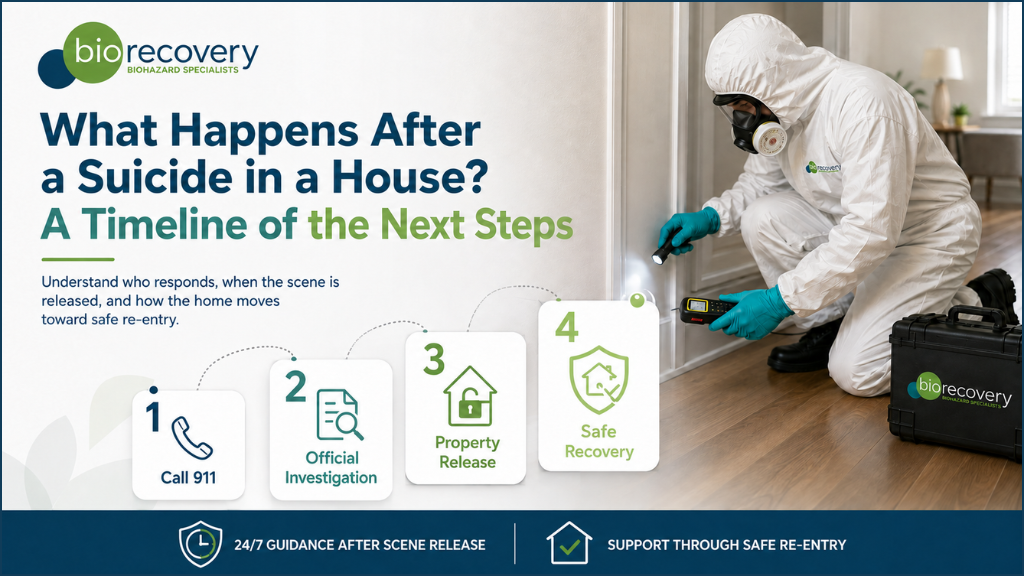
The first minutes after finding someone following a suicide can feel disconnected from everything that comes next. Emergency responders may arrive quickly, but questions about the investigation, body removal, the condition of the house, and who handles the physical aftermath often remain.
What happens after a suicide in a house follows a defined order. Authorities first secure and investigate the scene. Once they release the property, an authorized person can arrange a professional assessment, contact insurance, address affected belongings, and determine what the home needs before anyone returns to the area.
Blood, bodily fluids, and hidden contamination require more than ordinary cleaning. Professional suicide cleanup services address the affected materials while helping you understand the process from scene release through safe re-entry.
Step 1: Call 911 and Leave the Area Undisturbed
Call 911 immediately and follow the dispatcher’s instructions. Don’t move the person or touch anything nearby unless the dispatcher tells you to act.
If there is any chance the person is alive, describe exactly what you see. Emergency medical personnel will determine whether lifesaving care remains possible when they arrive.
While waiting for responders:
- Move away from any immediate danger.
- Keep children, pets, and visitors out of the area.
- Avoid blood, bodily fluids, weapons, and medications.
- Don’t clean, rearrange, or remove anything.
- Wait where the dispatcher tells you to wait.
These actions protect you and preserve the scene. More detailed guidance on what to do after finding a dead body explains what dispatchers may ask and what happens before responders arrive.
Step 2: Emergency Responders and Investigators Take Control
Emergency medical personnel first determine whether they can provide care. Once the death is confirmed, law enforcement secures the area and begins documenting what happened.
Police involvement does not mean the family or deceased committed a crime. A suicide requires an official investigation so the appropriate authority can establish the cause and manner of death.
The National Institute of Justice’s 2024 death investigation guide explains how investigators document deaths under medical examiner or coroner jurisdiction. State law and local procedures determine the exact response.
Who Handles Each Part of the Response?
Several professionals may enter the house, but their responsibilities remain separate.
| Party | Primary responsibility | Cleanup role |
|---|---|---|
| Emergency medical personnel | Determine whether care remains possible | None |
| Law enforcement | Secure and document the scene | None |
| Medical examiner or coroner | Investigate the death and oversee custody | None |
| Funeral home | Care for the deceased after release | None |
| Owner or representative | Authorize remediation and contact insurance | Arranges cleanup |
| Bio Recovery | Remove contamination and remediate the property | Performs cleanup |
The medical examiner or coroner may review medical records, scene findings, witness information, or toxicology results. An autopsy may also be ordered, but requirements vary by jurisdiction.
Once the required examination ends, the deceased is released to the funeral home selected by the family. Body removal does not include cleaning blood, bodily fluids, furniture, flooring, or other affected property.
The broader explanation of who cleans up after a death clarifies where the responsibilities of investigators, funeral homes, property representatives, and remediation specialists begin and end.
How Does This Differ From an Expected Death at Home?
A suicide requires an investigation, while an expected natural death under hospice care usually follows a different process. Hospice staff or a physician may handle the initial pronouncement without the same scene response.
The process of what happens after someone dies at home compares expected deaths, unexpected natural deaths, and deaths that require official review. It also explains why not every death at home requires specialized remediation.
Step 3: Wait for Authorities to Release the Property
Don’t clean, move, or repair anything until the investigating authority releases the scene. Changing the area too early can interfere with the investigation.
Ask the officer or investigator:
- Has the entire property been released?
- Do any rooms remain restricted?
- Were personal belongings taken as evidence?
- Who should you contact with later questions?
There is no standard release time for every house. Scene conditions, evidence collection, questions surrounding the death, and local procedures affect how long the investigation takes.
A scene release only means investigators have finished working at the property. It does not confirm that biological contamination has been removed or that the affected area is ready to occupy.
Step 4: Arrange a Professional Assessment
After the scene is released, the property owner or an authorized representative can arrange a biohazard assessment. That person may be the surviving homeowner, executor, estate representative, landlord, or property manager.
Lease terms, ownership documents, estate authority, and state law can affect who approves work in a rental or estate-owned property. When authority is unclear, review the relevant documents before authorizing remediation.
Why Shouldn’t You Clean the Scene Yourself?
Blood and bodily fluids can enter carpet padding, subflooring, upholstery, wall gaps, or other porous materials. Removing only what you can see does not address contamination below the surface.
Attempting cleanup can also transfer biological material to your skin, clothes, cleaning equipment, or unaffected rooms. Household products and equipment are not designed to locate the full extent of a trauma scene.
The CDC identifies needlesticks and contact with mucous membranes or non-intact skin as routes of exposure to bloodborne pathogens. Its May 2024 guidance lists hepatitis B, hepatitis C, and HIV among the pathogens of concern.
Understanding why biohazard exposure is dangerous provides more detail about contaminated surfaces, sharps, disturbed materials, and other potential exposure routes.
Step 5: Complete the Suicide Scene Remediation
Professional remediation addresses the affected area after authorities release it. Bio Recovery evaluates the scene, determines which materials can remain, and removes contamination that routine cleaning cannot safely address.
What Happens During Professional Suicide Cleanup?
The exact work depends on the location, affected materials, and extent of contamination. A typical remediation follows this process:
- Assess the scene. We identify visible contamination and inspect where biological material may have traveled.
- Control the work area. We limit access and take steps to prevent cross-contamination.
- Evaluate belongings. We separate unaffected property from items that need treatment or removal.
- Remove contamination. We remove biological material and porous materials that cannot be safely restored.
- Clean and disinfect. We treat salvageable surfaces using methods appropriate for each material.
- Review the completed work. We inspect and document the areas addressed.
- Identify repair needs. We note building materials that require replacement after remediation.
Remediation and reconstruction are separate. Remediation removes biological contamination, while reconstruction replaces flooring, drywall, baseboards, or other materials removed during the cleanup.
Can Personal Belongings Be Saved?
Some belongings can be recovered. Material, construction, location, and contact with contamination determine whether an item can be cleaned or must be removed.
Tell our team about photographs, documents, jewelry, electronics, and other meaningful items before work begins. Identifying priority belongings early allows us to consider them during the assessment.
Step 6: Contact Insurance and Understand the Cost
Homeowners insurance may cover biohazard remediation when the event falls within the policy’s terms. The insurance carrier decides whether coverage applies and how the deductible, exclusions, and policy limits affect the claim.
Ask the carrier:
- Whether the policy covers biohazard remediation
- Whether you need a claim number before work begins
- Which photographs or reports the adjuster requires
- How the policy handles damaged belongings
- Whether reconstruction receives separate consideration
Avoid discarding affected property before it is documented unless it presents an immediate safety concern. Bio Recovery can provide cleanup-related documentation, but the carrier makes the final coverage decision.
How Much Does Suicide Cleanup Cost?
There is no reliable flat rate for suicide cleanup. The amount of affected material and the work required to restore the property determine the cost.
| Cost factor | Why it matters |
|---|---|
| Size of the affected area | Larger areas require more labor and materials |
| Surface type | Porous materials may require removal |
| Contamination depth | Hidden migration can expand the work area |
| Affected belongings | Items require separate evaluation and handling |
| Structural removal | Removed flooring or drywall adds labor and disposal |
| Insurance terms | Coverage affects the owner’s final cost |
An assessment provides a more useful estimate than a general description over the phone. Two rooms with similar visible staining may require different work if contamination has reached different materials underneath.
Step 7: Confirm When the Area Is Ready for Use
The affected area can return to normal use after remediation is complete and any remaining property hazards have been addressed. Release by law enforcement ends the investigation at the house, not the cleanup process.
You may be able to use unaffected parts of the property while work continues if those areas can remain safely separated. Bio Recovery will explain which spaces should remain restricted based on the layout and conditions present.
Structural repairs may still be needed after remediation. If flooring, drywall, baseboards, or fixtures were removed, reconstruction can begin once the biohazard work is complete.
Support After a Suicide Loss
You don’t have to manage every call and property decision yourself. Ask someone you trust to take notes, communicate with professionals, care for children or pets, or organize important documents.
The person who discovered the scene may experience trauma connected to the house or affected room. Other relatives may respond differently based on what they saw and their relationship with the deceased.
SAMHSA provides current bereavement and grief resources for people who have experienced a loss and adults supporting children. If you or someone close to you is in emotional crisis or having thoughts of suicide, call or text 988.
Moving Forward After a Suicide in the House
What happens after a suicide in a house involves several separate responsibilities. Knowing where one stage ends and the next begins can help you make decisions without taking on work that belongs to investigators or trained remediation professionals.
- Call 911 and leave the person and surrounding area undisturbed.
- Law enforcement and the medical examiner or coroner must complete their work before the property can be altered.
- Body removal does not include cleaning or restoring the affected room.
- Cleanup can begin only after the investigating authority releases the scene.
- Blood and bodily fluids may reach materials below the visible surface, making household cleaning unsafe and incomplete.
- Bio Recovery assesses the contamination, evaluates affected belongings, removes materials that cannot remain, and treats salvageable surfaces.
- Insurance coverage and cleanup costs depend on the policy and the actual conditions inside the property.
- The affected area should not return to normal use until remediation is complete and any remaining repair needs have been addressed.
You don’t have to determine the condition of the property or manage the physical aftermath yourself. Reach out to our team after authorities release the scene, and Bio Recovery Biohazard Specialists will explain what the home needs next.
Frequently Asked Questions
1. Who is responsible for cleaning up after a suicide?
The property owner or an authorized representative usually arranges professional cleanup. In a rental or estate-owned property, ownership documents, lease terms, estate authority, and insurance may affect responsibility.
2. What professional services handle suicide scene cleanup in a house?
A specialized biohazard remediation company handles suicide scene cleanup. Bio Recovery assesses the contamination, removes affected materials, treats salvageable surfaces, and documents the completed work.
3. How soon can suicide cleanup begin?
Cleanup can begin after law enforcement or the investigating authority formally releases the property. Starting earlier could disturb evidence and interfere with the investigation.
4. Does homeowners insurance cover suicide cleanup?
Homeowners insurance may cover biohazard remediation when the loss meets the policy’s terms. The insurance carrier must confirm coverage, deductibles, limits, documentation requirements, and authorization.
5. Are there specialized companies that offer trauma cleanup for suicide cases?
Yes. Bio Recovery provides specialized biohazard and trauma scene remediation for suicide cases in houses, apartments, rental properties, and other residential settings across the United States.