



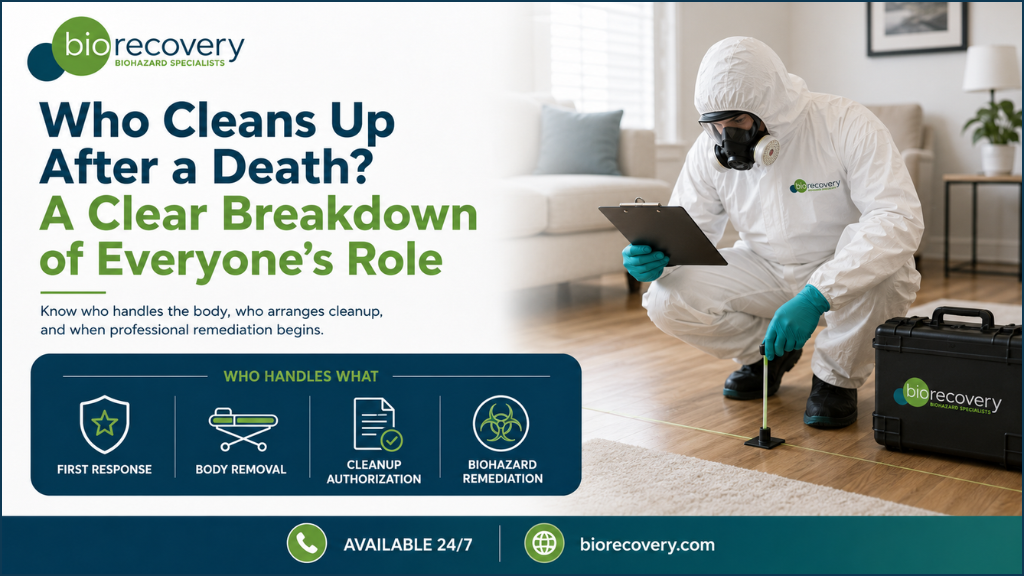
When someone dies at home, several professionals may respond, but their responsibilities stop at different points. Police secure the scene, the medical examiner may investigate, and a funeral home or authorized team transports the deceased. None of these roles usually includes restoring the property.
So, who cleans up after a death? The property owner or authorized representative generally arranges professional death cleaning services when blood, bodily fluids, or decomposition affect the space.
Understanding who removes the deceased, when cleanup can begin, who authorizes the work, and what technicians handle can prevent confusion during an already difficult time.
Who Cleans Up After a Death?
A professional biohazard remediation company cleans the property when a death leaves blood, bodily fluids, tissue, or decomposition behind. The property owner or authorized representative usually arranges the service after the scene has been released.
| Party | Primary Responsibility | Cleanup Role |
|---|---|---|
| Police and first responders | Emergency response and scene control | Do not restore the property |
| Coroner or medical examiner | Death investigation and custody of the deceased | Does not clean the property |
| Funeral home or transport service | Transportation and care of the deceased | Does not clean the property |
| Property owner or representative | Authorizing cleanup and repairs | Arranges the work |
| Biohazard remediation company | Removing contamination and disinfecting affected areas | Performs the cleanup |
| Restoration contractor | Replacing removed building materials | Works after remediation |
These roles can vary under local procedures, state law, lease terms, and property agreements. The table reflects the most common process for deaths on private property.
What Should You Do Before Cleanup Begins?
Do not touch the body or begin cleaning before the appropriate emergency or medical personnel respond. Your first actions depend on whether the death was expected.
Follow these immediate steps:
- Call 911 if the death was unexpected or you aren’t sure whether the person has died.
- Contact the hospice provider first if the death was expected under hospice care.
- Keep children, pets, and other visitors away from the area.
- Do not move the person or nearby belongings unless a dispatcher instructs you to act.
- Wait until authorities release the property before arranging cleanup.
These actions protect you and preserve anything officials may need to examine. Knowing what to do after finding a dead body provides more guidance for the period before responders arrive.
Who Picks Up the Body After a Death?
A funeral home usually picks up the body after an expected death has been officially pronounced. For a sudden, unexplained, accidental, or potentially criminal death, the coroner or medical examiner may take custody first.
| Situation | Who Usually Takes Custody? | When Transportation Occurs |
|---|---|---|
| Expected death under hospice care | Funeral home | After pronouncement |
| Expected natural death without hospice | Funeral home | After an authorized pronouncement |
| Unexpected death requiring review | Coroner or medical examiner | During the investigation |
| Death requiring an autopsy | Coroner or medical examiner | Before release to the funeral home |
The broader sequence of what happens after a home death explains how pronouncement, official review, transportation, and property responsibilities fit together.
Where Does Body Removal End and Cleanup Begin?
Body removal ends when an authorized team transfers the deceased from the scene. Cleanup begins after officials release the affected area and permit the property owner to alter it.
The transport team does not usually remove contaminated flooring, furniture, or building materials. Those items remain for the biohazard cleanup company to assess.
Who Is Responsible for Cleaning the Property?
The person or organization that owns or controls the property usually arranges the cleanup. Responsibility changes with the type of property and any applicable lease, management, or insurance agreements.
| Property Type | Who Usually Arranges Cleanup? | What Can Affect Responsibility? |
|---|---|---|
| Private home | Homeowner or estate representative | Ownership, estate authority, and insurance |
| Rental home | Landlord or property manager | Lease terms, local law, and insurance |
| Business or facility | Operator, business owner, or property owner | Contracts and commercial coverage |
| Public property | Agency responsible for the location | Local procedures and jurisdiction |
A relative may coordinate the work as an executor without personally paying for it. When responsibility is unclear, review the property agreement and contact the relevant insurance carrier.
When Is Professional Cleanup Necessary After a Death?
Professional cleanup is necessary when blood, bodily fluids, tissue, decomposition, or contaminated sharps affect the property. A promptly discovered natural death may only require ordinary housekeeping when no biological material reached the surroundings.
Request a professional assessment when you find:
- Visible blood or bodily fluids
- Decomposition fluid or staining
- Contamination beneath carpet or flooring
- Persistent decomposition odor
- Insect activity around the affected area
- Contaminated bedding or furniture
- Needles or other sharps
- Uncertainty about where the affected area ends
Blood can expose workers to infectious microorganisms. The CDC identifies hepatitis B, hepatitis C, and HIV among the common bloodborne pathogens connected with occupational exposure.
Contamination can also remain in places that look clean. The dangers of biohazard exposure help explain why seams, padding, and other concealed materials may require professional evaluation.
Who Cleans Up After a Dead Body Has Decomposed?
Trained biohazard technicians clean a property after a decomposed body has been removed and officials have released the scene. Cleanup focuses on the areas and materials affected by biological fluids or decomposition odor.
Time and indoor conditions influence the scope. A timeline of how long decomposition takes in a house explains how temperature, humidity, airflow, and surrounding materials affect the property.
Does the Whole House Need Cleaning?
No. Cleanup should follow the actual boundaries of contamination rather than include every room automatically.
Technicians may inspect adjacent spaces because odors can travel and foot traffic can spread biological material. Odor outside the original room does not, by itself, prove that fluid contamination reached that area.
What Materials May Need Removal?
Absorbent materials may require removal when biological fluids penetrate too deeply for reliable cleaning. Common examples include:
- Carpet and padding
- Mattresses and upholstered furniture
- Drywall and insulation
- Sections of wood flooring or subfloor
- Heavily contaminated paper or fabric items
Nonporous objects are often easier to clean, while porous belongings require individual evaluation. Tell Bio Recovery about photographs, documents, jewelry, keys, or other important items before cleanup begins.
The physical effects covered in what happens to a home after a death explain how contamination and odor can affect flooring, walls, belongings, and other parts of the property.
What Do Companies That Clean Up After a Death Do?
Companies that clean up after a death remove biological contamination and prepare the affected space for safe use or structural restoration. This work is different from routine housekeeping or an estate cleanout.
At Bio Recovery, the process follows the conditions found during the assessment:
- Assess the scene. Technicians identify visible damage, possible hidden contamination, and the boundaries of the work area.
- Control access. The affected space is isolated to protect occupants and reduce cross-contamination.
- Remove contamination. Biological material and items that cannot be restored are removed from the work area.
- Clean and disinfect. Restorable surfaces receive treatment based on the material and type of contamination.
- Address odors. Odor treatment targets the source rather than covering the smell.
- Document the work. Records identify treated areas and materials removed from the property.
Disposal requirements vary by location. The EPA states that medical waste is primarily regulated by state environmental and health departments, so handling requirements differ across the United States.
How Is Death Cleaning Different From an Estate Cleanout?
Death cleaning removes biological contamination, while an estate cleanout sorts ordinary possessions. Biohazard remediation should happen first when belongings sit inside an affected area.
Structural restoration also occurs after remediation. A restoration contractor replaces flooring, drywall, or other building materials that technicians removed during cleanup.
Who Pays for Cleanup After a Death?
Payment may come from property insurance, estate funds, the property owner, or another eligible source. Who arranges the service and who ultimately pays are not always the same person.
Homeowners insurance may cover remediation when the death qualifies as a covered event. Commercial policies may apply to businesses, while some crime-related incidents may qualify for state victim assistance.
The full explanation of who pays for biohazard cleanup covers how costs and insurance responsibility can differ for homeowners, landlords, renters, businesses, and estates.
How Do You Evaluate People Who Clean Up After Death?
Choose people who clean up after death based on how clearly they define the affected area, necessary work, and limits of the cleanup scope. You should understand what will receive treatment before approving the service.
Ask these questions:
- How will you identify the boundaries of contamination?
- Which materials can be cleaned, and which require removal?
- How will you handle contaminated waste?
- What documentation will you provide for insurance?
- Does the estimate separate remediation from rebuilding?
The proposed scope should reflect the actual property conditions. Treating an entire house should only be recommended when the assessment supports that level of work.
Frequently Asked Questions
These answers address the most common questions about responsibility, transportation, cost, and insurance after a death.
Who is responsible for cleaning up after a death?
The property owner or person controlling the premises usually arranges cleanup after authorities release the scene. Rental and commercial responsibilities can depend on property agreements, insurance, and local law.
How much does it cost to clean a house after a death?
The cost depends on the affected area, time before discovery, materials involved, waste volume, and structural damage. An on-site assessment provides the most accurate estimate.
Does homeowners insurance cover clean up after a death?
Homeowners insurance may cover biohazard remediation when the incident qualifies as a covered loss. Coverage depends on the policy, cause of death, deductible, exclusions, and repair needs.
Who picks up the body after a death?
A funeral home usually transports the deceased following an expected death and official pronouncement. The coroner or medical examiner may take custody first when a death requires investigation.
Key Takeaways About Who Cleans Up After a Death
- A funeral home usually transports the deceased after an expected death, while the coroner or medical examiner may take custody when an investigation is required.
- Police, medical examiners, and funeral homes generally do not clean or restore the property.
- The property owner or authorized representative usually arranges cleanup after officials release the scene.
- Professional remediation is appropriate when blood, bodily fluids, decomposition, tissue, or contaminated sharps affect the property.
- Cleanup should follow the actual boundaries of contamination rather than automatically include the entire home.
- Insurance, estate funds, the property owner, or another eligible source may cover the cost.
- Biohazard cleanup must occur before an estate cleanout or structural restoration begins in an affected area.
If you need help determining what your property requires, our 24/7 team can assess the situation and explain the next step.